
Location: Hamburg, Germany
Institution: University Medical Center Hamburg-Eppendorf (UKE)
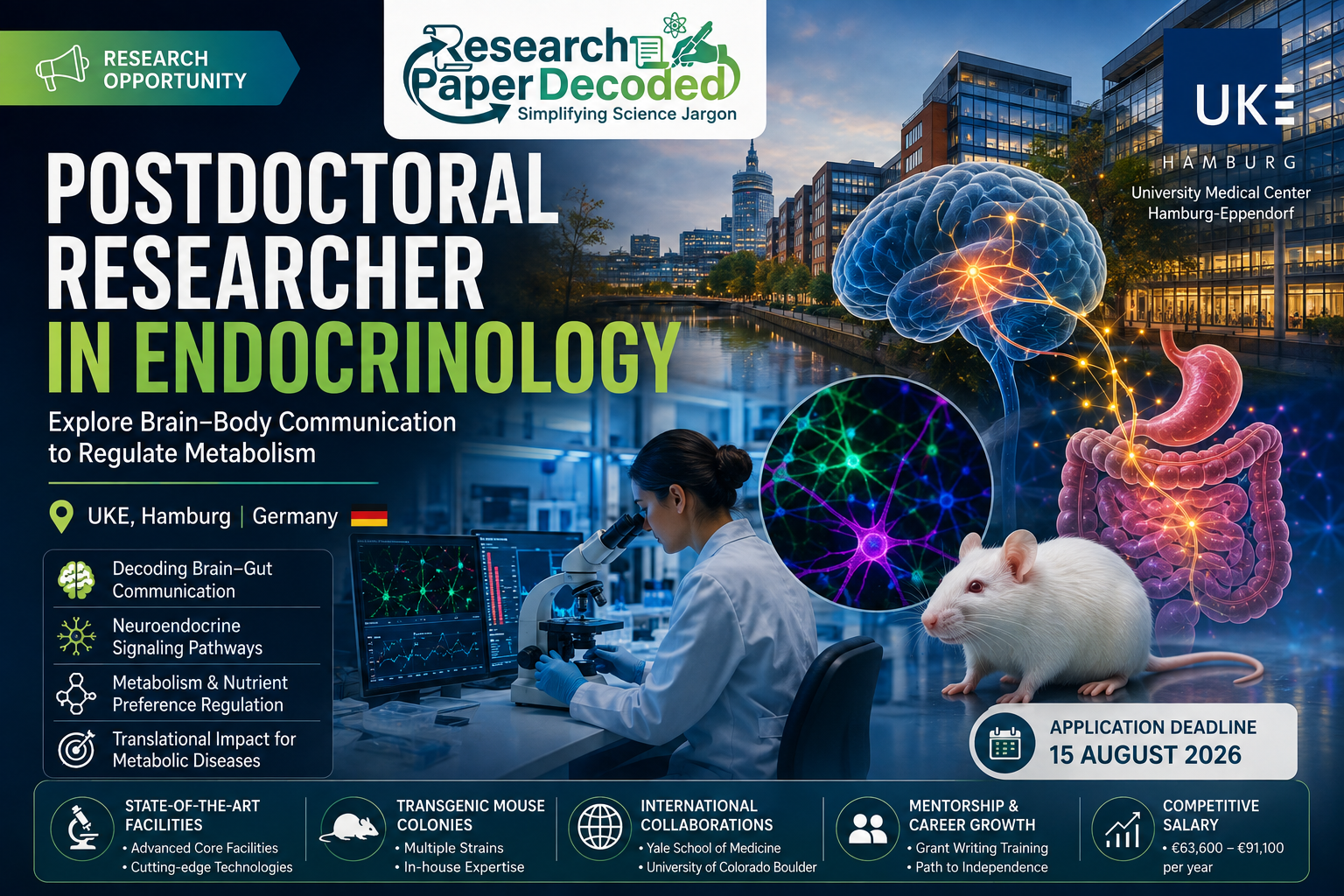
Position: Postdoctoral Researcher (All Genders)
Application Deadline: 15 August 2026
Employment Type: Full-time / Part-time | Temporary (until March 2029)
Salary: €63,600 – €91,100
Contact: jaschke@uke.de
Looking for a Postdoctoral Position in Metabolism, Neuroscience, or Translational Medicine?
The University Medical Center Hamburg-Eppendorf (UKE) is inviting applications for a Postdoctoral Researcher in the Department of Endocrinology. This position offers an opportunity to investigate how the brain and body communicate to regulate metabolism and dietary behavior using interdisciplinary approaches spanning endocrinology, neuroscience, physiology, metabolism, and immunology.
Researchers interested in metabolism, neuroendocrinology, translational medicine, and animal models may find this position particularly attractive.
Scientific Project Explained
Understanding Brain–Body Communication During Metabolic Stress
Every physiological process requires constant communication between organs. During illness, fasting, or severe weight loss, the body’s nutritional demands change dramatically. However, scientists still do not fully understand how the brain determines which nutrients should be consumed during recovery.
The laboratory recently identified stereotypical adaptive dietary preferences during recovery from catabolic states, mediated through a gut-to-brain signalling pathway. Building upon these findings, the current project aims to investigate how nutrient “set points” are established and regulated throughout different physiological conditions across the lifespan.
Specifically, the project seeks to answer questions such as:
- How does the brain receive information about nutritional status?
- Which neuroendocrine pathways regulate nutrient selection?
- How do dietary preferences change following physiological stress?
- What molecular mechanisms coordinate communication between peripheral organs and the central nervous system?
- Could manipulating these signalling pathways lead to future therapies for metabolic diseases?
The research integrates concepts from:
- Endocrinology
- Metabolism
- Neuroscience
- Comparative Physiology
- Evolutionary Biology
- Biochemistry
- Translational Immunology
For researchers interested in mechanistic biology, this project offers the opportunity to combine physiology with molecular and systems-level approaches.
Meet the Principal Investigator
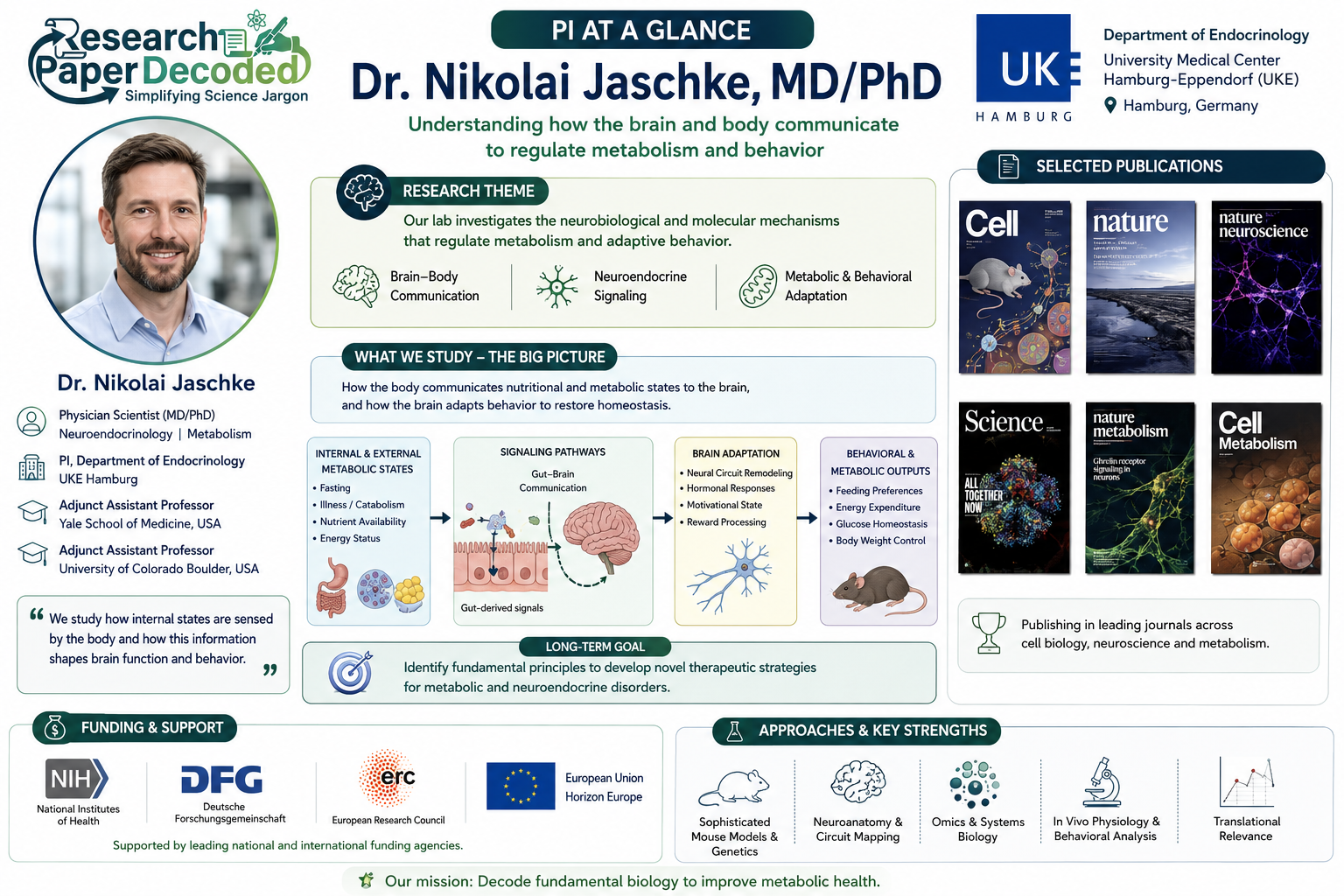
The position is associated with Dr. Nikolai Jaschke (MD/PhD) from the Department of Endocrinology at UKE, who is listed as the departmental contact in the advertisement.
Based on the advertisement, Dr. Jaschke’s laboratory focuses on understanding communication between the brain and peripheral organs in both health and disease. The lab recently reported findings on adaptive dietary preferences during recovery from catabolic states and is now expanding this work to investigate the neuroendocrine regulation of nutrient sensing and metabolic adaptation.
Beyond the scientific programme, the advertisement indicates that postdoctoral researchers will receive close mentorship from the PI with the explicit goal of developing into independent scientists. Training in grant writing, experimental design, and scientific leadership is highlighted as part of the laboratory’s mentoring philosophy.
Research Facilities and Scientific Environment
One of the strongest aspects of this opportunity is the research infrastructure available to postdoctoral fellows.
Successful candidates will work in an interdisciplinary environment involving clinicians, immunologists, infectious disease researchers, metabolism scientists, and neuroscientists. The laboratory is physically embedded within the Hamburg Center of Translational Immunology (HCTI), enabling close interaction with multiple research disciplines.
The advertisement also highlights access to:
- State-of-the-art experimental facilities
- Multiple institutional core facilities
- An independent rodent colony containing several transgenic mouse strains
- Cross-disciplinary collaborations within UKE
- International collaborations, including research groups at Yale School of Medicine and the University of Colorado Boulder
- Opportunities to visit collaborating laboratories and acquire new experimental techniques when required
Unlike many postdoctoral positions where researchers are confined to a single laboratory, this environment encourages interaction across disciplines while providing access to sophisticated animal models and modern research infrastructure.
Who Should Apply?
This opportunity is ideal for researchers who have:
Essential Qualifications
- PhD in
- Biology
- Veterinary Medicine
- or related life science disciplines
Preferred Research Background
Experience in one or more of the following areas:
- Metabolism
- Ribosomal biology
- Developmental biology
- Physiology
- Comparative physiology
- Neuroscience
- Neuroendocrinology
Additional Requirements
Applicants should ideally have:
- Minimum 3 years experience working with mice
- FELASA animal training certification (preferred)
- Experience in mouse colony management
- Strong publication record
- Two recommendation letters
- Passion for scientific discovery
- Broad scientific interests
Salary & Benefits
Successful candidates will receive:
- Salary between €63,600 and €91,100 per year
- Professional development programs
- Grant-writing support
- Access to advanced research infrastructure
- International collaborations
- Continuing education through UKE Academy
- Family-friendly workplace
- Sports and wellness programs
- Structured onboarding
- Long-term career development opportunities
Application Deadline
15 August 2026
Applicants should submit their application before the deadline through the official recruitment portal.
Career Development
Many postdoctoral advertisements focus solely on technical responsibilities. UKE additionally emphasises career development.
The selected candidate will receive:
- Close mentorship from the Principal Investigator
- Training towards scientific independence
- Guidance in grant writing
- Opportunities to develop collaborations nationally and internationally
- Professional development through the UKE Academy
- Exposure to large interdisciplinary research projects
These features suggest that the position is designed not only to produce research outputs but also to prepare fellows for independent academic careers.
PaperDecoded Quick Take
This opportunity stands out because it combines high-quality infrastructure, international collaborations, and structured mentorship with a mechanistic research programme addressing fundamental questions in metabolic physiology. Rather than focusing narrowly on a single pathway, the project integrates endocrinology, neuroscience, physiology, and translational medicine to understand how the brain and peripheral organs coordinate nutrient regulation during health and disease.
For applicants seeking a postdoctoral position that balances rigorous experimental science with opportunities for professional growth toward research independence, this role offers a compelling combination of scientific depth and career development.
For Detail Advertisement Click Here

Editor, Research Paper Decoded