
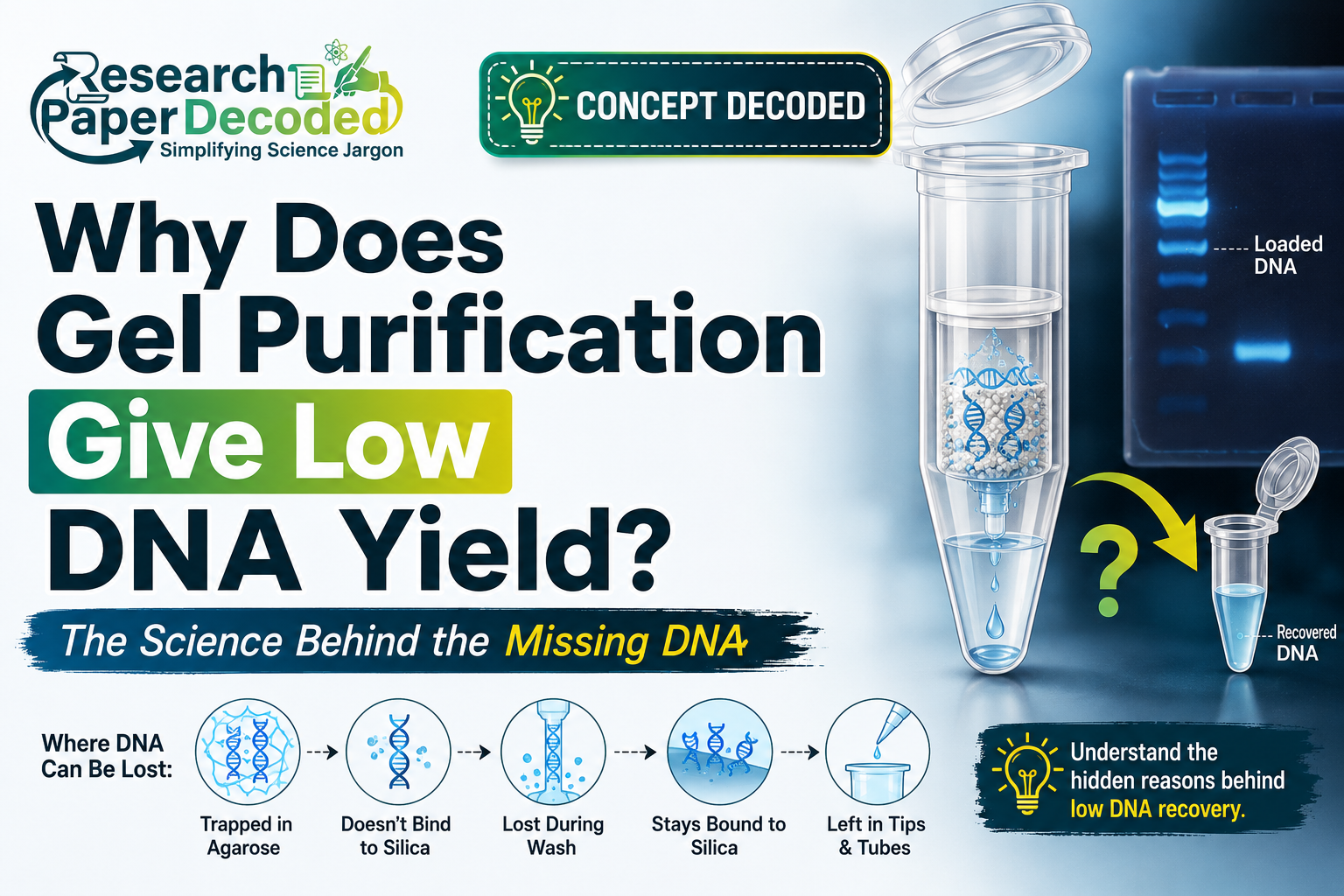
“I loaded a bright DNA band into the gel. So why did I recover only 45 ng instead of 100 ng?” If you’ve searched “Why is DNA yield low after gel purification?”, “Where did my DNA go after gel extraction?”, or “Why doesn’t the silica column release all the DNA?” you’re not alone. Most protocols explain how to improve DNA recovery but rarely explain why DNA is lost in the first place. In this Concept Decoded article, we’ll uncover the molecular science behind gel purification and reveal where your missing DNA actually goes and reveal why recovering 100% of your DNA loaded on agarose gel is practically impossible.
Where Does Your DNA Go During Gel Purification?
Imagine this. You amplified your DNA perfectly with PCR. Or you digested a DNA with restriction endonucleases and planned to purify the desired DNA based on the agarose gel DNA bands. The DNA fragment band was bright. You carefully excised the correct band from the gel. You followed every step of the gel purification protocol exactly as instructed. Finally, you measured your DNA concentration. Instead of recovering 100 ng, you recovered only 45 ng. The obvious question is… Where did the other 55 ng go?
Did it disappear? Did it degraded? Did it evaporate out? Did it remain trapped inside the gel? Or is it still hiding inside the silica column?
Surprisingly, most protocols tell you how to improve DNA recovery but almost never explain why DNA recovery is never complete in the first place. Today, let’s investigate this mystery.
The Mystery Begins: DNA Shouldn’t Even Bind to Silica!
Before asking why DNA doesn’t come off the silica column, we should ask a more fundamental question.
Why does DNA bind to silica at all?
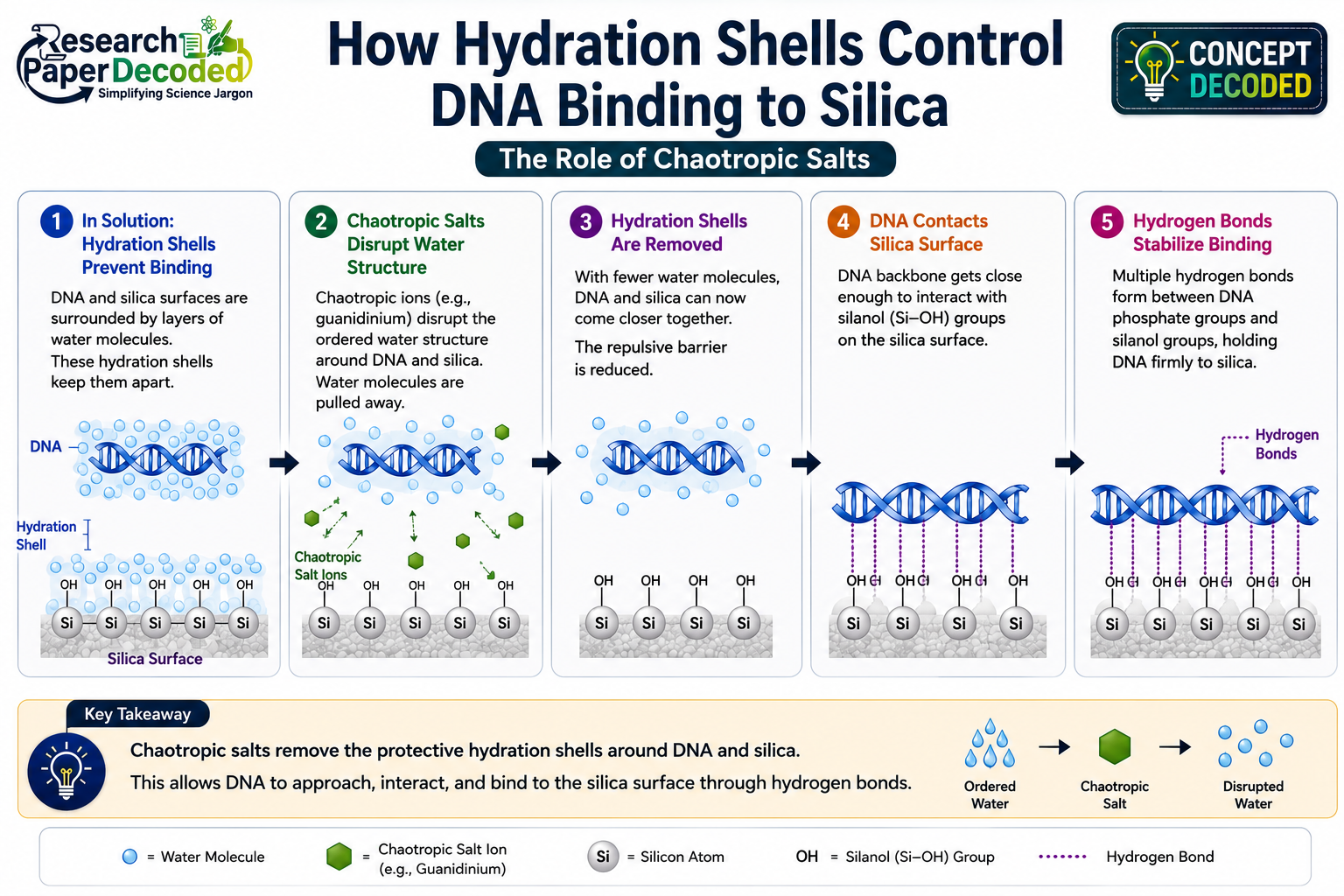
DNA carries a negatively charged phosphate backbone. Silica surfaces are also covered with negatively charged silanol (Si–OH) groups. Remember basic electrostatics? Negative charges repel each other. So under normal conditions, DNA should refuse to stick to silica. Yet every commercial purification kit depends on this very interaction. How is that possible?
The Secret Ingredient: Chaotropic Salts Change Everything
The answer lies in the binding buffer. Gel extraction kits contain high concentrations of chaotropic salts, such as guanidinium salts. These salts perform two remarkable jobs. First, they disrupt the ordered structure of water surrounding both DNA and silica. Normally, both surfaces are wrapped in a tightly bound hydration shell. You can imagine this water layer as a protective cushion that prevents DNA and silica from making direct contact. Chaotropic salts strip away much of this protective water. Suddenly, DNA and silica can approach each other closely enough to form hydrogen bonds and other intermolecular interactions.
In other words, the binding buffer doesn’t make DNA sticky—it removes the water that was preventing DNA from sticking. That is why DNA suddenly adsorbs to silica.
Why Doesn’t All DNA Reach the Silica Column?
Once the gel slice is placed into dissolution buffer and heated to dissolve the solid agarose gel, most people assume every DNA molecule is released. Unfortunately, agarose has other plans. Agarose is not simply a “gel.” It is a three-dimensional meshwork made of microscopic pores. Imagine trying to pull a long piece of noodle through a fishing net. Some strands slide out easily. Others loop around the mesh and become trapped.
DNA behaves similarly. During gel dissolution, most DNA molecules escape from the agarose network. However, some remain physically entangled within microscopic agarose structures or become trapped in incompletely dissolved regions. Those molecules never even reach the silica membrane. Your DNA loss has already begun.
Why Doesn’t Every DNA Molecule Bind to Silica?
Suppose every DNA molecule successfully leaves the agarose. Shouldn’t they all bind? Not necessarily. Binding is not an “ON/OFF” switch. It is an equilibrium. Some DNA molecules encounter the silica membrane immediately. Others remain suspended in solution. Some fragments bind through multiple contact points. Others make only weak interactions.
At the same time, liquid continues flowing through the column. Any DNA molecule that fails to establish sufficient interactions before the solution passes through is carried away into the collection tube. In other words, binding is a race between adsorption and flow. Not every DNA molecule wins that race.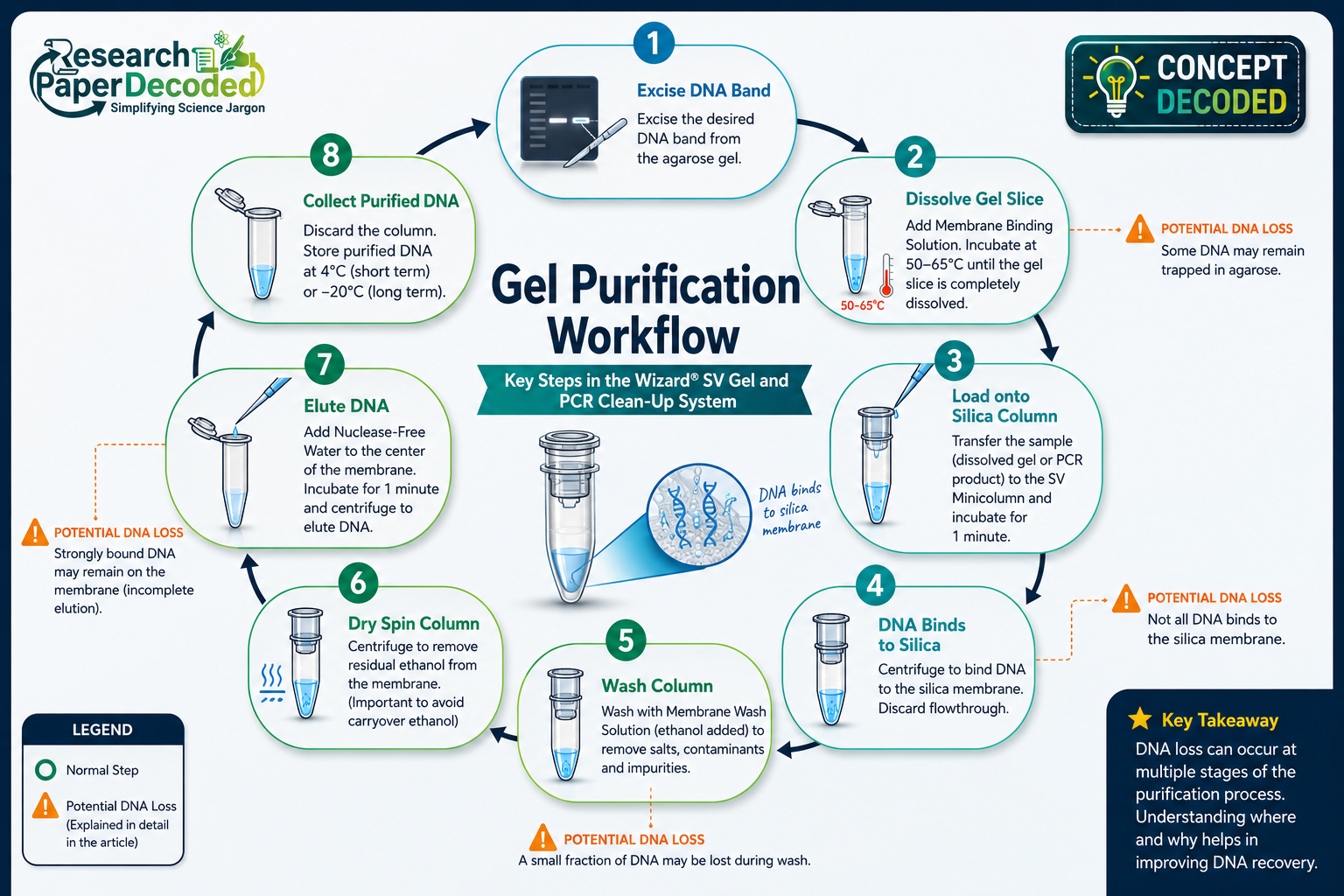
If DNA Binds, Why Doesn’t Water Remove All of It?
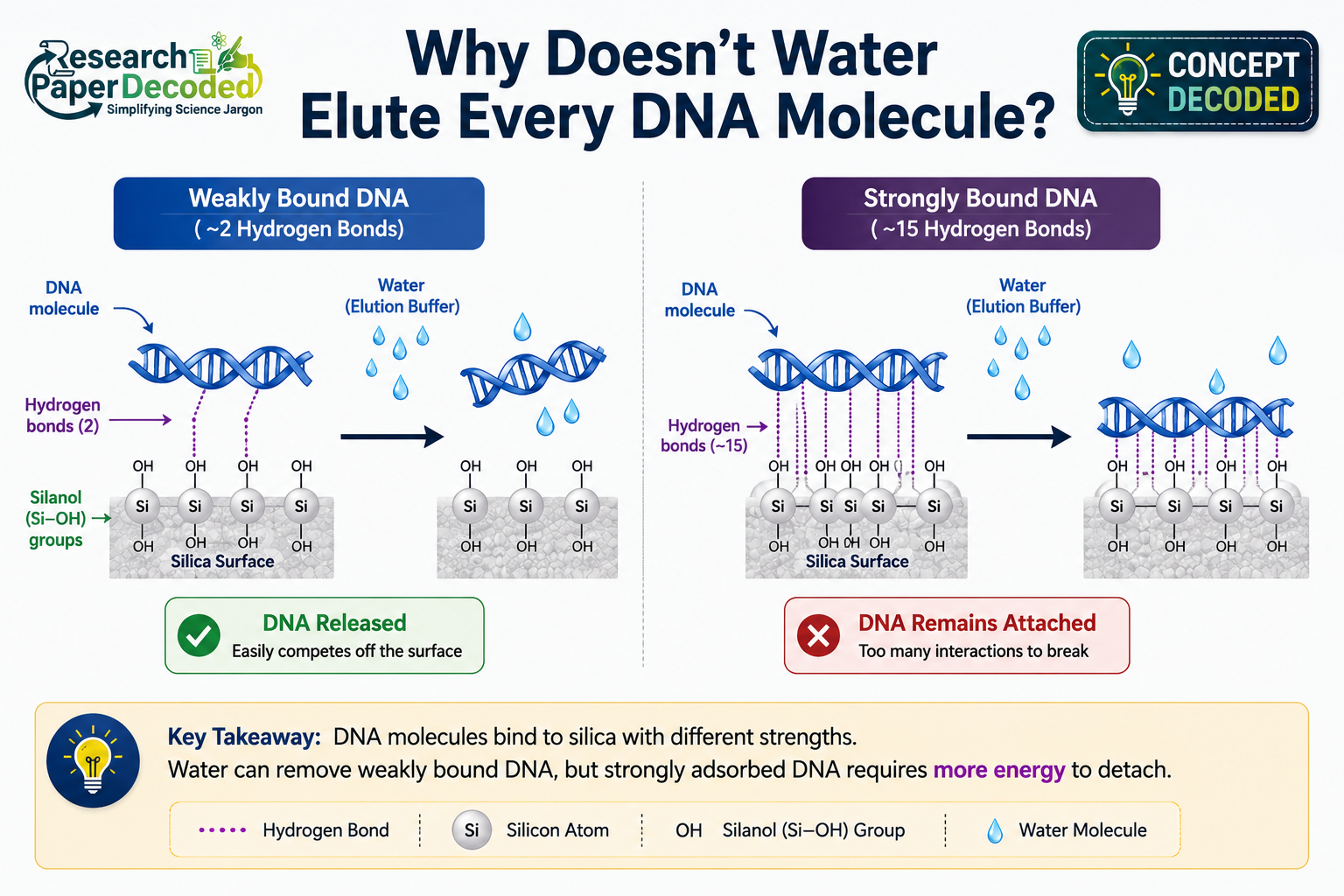
This is perhaps the most overlooked question in molecular biology. After washing the column, we add elution buffer or water. If water can release DNA the why doesn’t it release every DNA molecule?
The answer lies in molecular competition. Water molecules compete with DNA for hydrogen bonding sites on the silica surface. Many DNA molecules lose this competition and detach. However, not all DNA molecules are attached equally. Some molecules bind through only one or two contact points. Others lie flat against the silica surface and interact through many phosphate groups simultaneously.
Some DNA even penetrates microscopic pores within the silica matrix. These molecules behave almost like Velcro. Breaking one interaction is easy. Breaking dozens of interactions at the same time requires much more energy. As a result, the first elution releases the loosely bound DNA. The strongly bound population often remains attached to the membrane.
This is precisely why a second elution frequently recovers additional DNA. The first elution removed the easy molecules. The second recovers some of the stubborn ones. Some still remain and you find low yield of DNA after gel purification.
Why Doesn’t Ethanol Wash the DNA Away?
Another interesting question. During washing, large volumes of ethanol-based buffer pass through the column. Why isn’t the DNA washed away? Because ethanol behaves very differently from water. Ethanol lowers the dielectric constant of the solution and does not compete effectively for the hydrogen bonds that anchor DNA to silica. Instead of weakening DNA-silica interactions, ethanol helps preserve them while removing salts and contaminants. That is why DNA remains attached during the wash but begins to detach only after exposure to water or low-salt elution buffer.
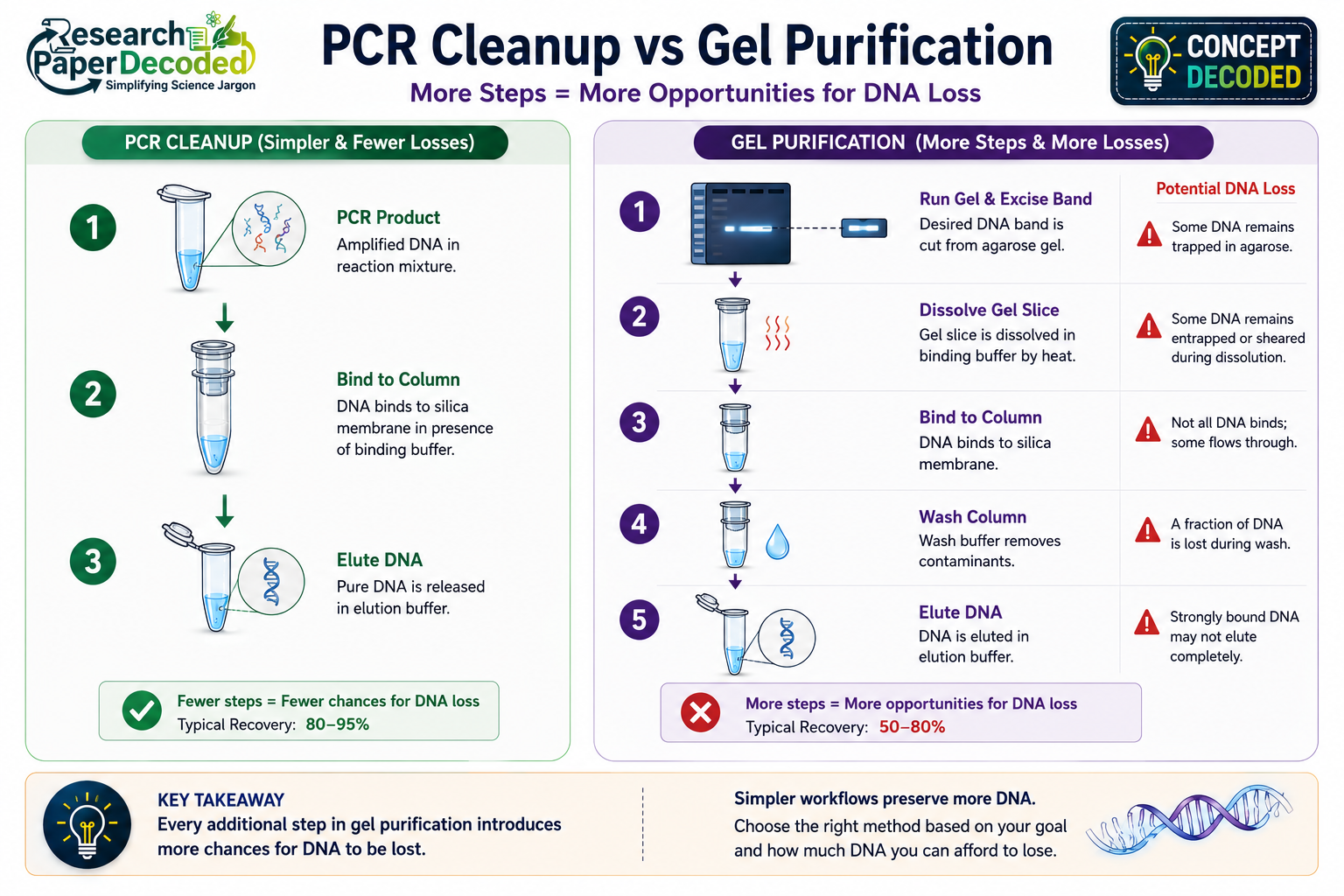
Why Does PCR Cleanup Recover More DNA?
Researchers often notice something interesting. A PCR cleanup kit may recover 80–95% of the PCR product. The same DNA purified from an agarose gel might recover only 50–70%. But Why? Because PCR cleanup skips several opportunities for DNA loss. There is:
- no agarose network trapping DNA,
- no gel excision,
- no incomplete gel dissolution,
- fewer transfer steps,
- and less physical handling.
The silica chemistry is almost identical. The difference lies in everything that happens before the DNA reaches the silica membrane.
So…Where Did Your DNA Actually Go?
Let’s return to our original 100 ng. The missing DNA wasn’t lost at one dramatic moment. Instead, small fractions disappeared throughout the journey. Some remained trapped inside agarose. Some never reached the silica membrane. Some flowed through before binding. Some detached during washing. Some remained tightly adsorbed to silica after elution. A tiny amount adhered to pipette tips and plastic tubes.
No single step explains the entire loss. The final recovery is simply the cumulative result of many small, unavoidable inefficiencies during gel extraction of DNA.
Can We Ever Achieve 100% DNA Recovery?
Probably not. Gel purification is fundamentally a recovery process, not a perfect transfer process. Every molecular interaction that allows DNA to bind efficiently also makes complete release impossible. Ironically, if DNA bound only weakly, much of it would wash away. If DNA binds very strongly, some of it refuses to elute. Commercial purification kits are carefully designed to balance these opposing forces. The goal is not perfect recovery. The goal is the highest practical recovery with sufficient purity for downstream applications.
PaperDecoded Quick Take
The DNA you “lose” during gel purification has not mysteriously disappeared.
It is scattered across the entire workflow—some trapped in agarose, some washed away before binding, and some still clinging tightly to the silica membrane long after the elution is complete.
In our laboratory, I have observed that excising a larger gel slice and prolonged exposure to UV light consistently reduced recovery. Minimizing UV exposure and trimming excess agarose improved DNA yield after gel purification.
Understanding this transforms gel purification from a black-box protocol into a process governed by molecular interactions, equilibrium, and physical constraints. The next time your DNA yield seems disappointingly low, remember: The silica column didn’t fail. It simply obeyed chemistry.
Want to Explore the Science Further?
Key Research Papers
- Vogelstein, B. and Gillespie, D. (1979) ‘Preparative and analytical purification of DNA from agarose.,’ Proceedings of the National Academy of Sciences, 76(2), pp. 615–619. https://doi.org/10.1073/pnas.76.2.615.
- Boom, R. et al. (1990) ‘Rapid and simple method for purification of nucleic acids,’ Journal of Clinical Microbiology, 28(3), pp. 495–503. https://doi.org/10.1128/jcm.28.3.495-503.1990.
- Wizard® SV Gel and PCR Clean-Up System Technical Bulletin (no date). https://www.promega.in/resources/protocols/technical-bulletins/101/wizard-sv-gel-and-pcr-cleanup-system-protocol/.
- QIAGEN Gel Extraction Handbook.
- Thermo Fisher GeneJET Gel Extraction Kit Manual

Editor, Research Paper Decoded