
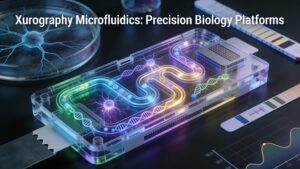
Microfluidics—the art of wrangling tiny fluid volumes in channels thinner than a hair—powers mimicking the biological in-vivo environment for accessing biological mystery. But traditional methods like photolithography demand expensive cleanrooms and weeks of hassle, limiting students, small labs, and resource limited innovators. Xurography flips the script: grab a desktop cutter (think upgraded Cricut), some adhesive tape, and you’re fabricating functional chips in under an hour. It’s the ultimate DIY hack for lab-on-a-chip, perfect for biology labs on a budget. [Read More]
What is Xurography, Really?
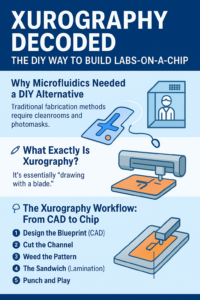
Picture “drawing with a razor”—that’s Xurography from its Greek roots. A computer-controlled blade on a cutting plotter slices designed delicate patterns into thin films like vinyl, PET sheets, or double-sided tape or Kapton tape. [Read More] Stack these cut layers between substrates (glass slides, plastic, or PDMS), and boom: sealed microchannels, typically 100-200 μm wide, ready for fluids. [Read More]
No cleanrooms, no chemicals, no UV lights. Just free 2D CAD software, a $200-300 plotter, and office-supply tapes. Researchers love it because you can iterate designs the same day—tweaking mixers or chambers on the fly with zero hassle. . [Read More]
Your 5-Minute Workflow: Sketch to Flow
This benchtop process is student-proof and endlessly tweakable:
- Design in CAD: Draw channels, valves, or chambers (keep features >150 μm for clean cuts).
- Cut the film: Load adhesive tape or vinyl; plotter blades the pattern.
- Weed excess: Peel away waste—your peeled spots become fluid paths.
- Laminate sandwich: Align between PET/glass/PDMS sheets for sealed channels.
- Punch & test: Add inlets/outlets, inject fluids, and watch it work! [Read More]
Stack layers for 3D magic like gradient generators. It’s sticker-craft meets science—fail fast, fix faster. [Read More]
Materials That Anyone Can Grab
- Channel stars: Double-sided tapes, vinyl, PET—flexible, cheap, bio-friendly.
- Supports: Glass for clear optics, PDMS for cells, acrylic for toughness.
- Advanced picks: Fluoropolymers for solvents, graphene paper for sensors. [Read More]
These combos shine in bioassays, from enzymes to live cells, without compatibility headaches. [Read More]
Game-Changing Wins in Biology & Education
Xurography isn’t hype—it’s battle-tested for real bio work:
- Cell cultures & organ-chips: Builds neuron platforms and disease models with precise microenvironments. [Read More]
- Drug screening: Cheap parallel tests for toxicity, ideal for neuro research.
- POC diagnostics: Disposable paper-hybrid chips for infections—think field-ready LAMP-LFA vibes. [Read More]
- Teaching tools: Hands-on chips for classrooms, no big budgets needed. [Read More]
It empowers low-resource labs, startups, and your next experiment. [Read More]
The Real Talk: Limits & Fixes
Honest upsides come with trade-offs:
- Resolution caps at ~100-200 μm (great for bio flows, skips nano-precision). [Read More]
- Manual alignment or blade wear can cause leaks/variability—test prototypes early.[Read More]
- Not for sub-10 μm feats, but crushes 80% of bio/diagnostic needs. [Read More]
Pro tip: Calibrate your plotter and use quality tape to minimize quirks. [Read More]
Quick Comparison: Xurography vs. The Rest
| Feature | Xurography | Photolithography | 3D Printing |
| Cost | Very low | Very high | Medium |
| Time | Minutes-hours | Days | Hours |
| Cleanroom? | No | Yes | No |
| Resolution | 100-200 μm | <10 μm | 100+ μm |
| Best for | DIY prototypes, disposables, teaching | High-precision | Complex 3D |
Xurography wins for speed and access—your go-to for biology prototyping.
Editor, Research Paper Decoded