
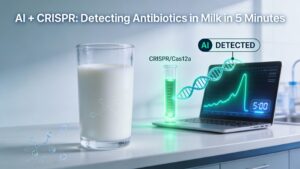
AI + CRISPR: Detecting Antibiotics in Milk in 5 Minutes:
Antibiotic residues in milk are a silent public health threat. When livestock farmers use antibiotics—whether appropriately or excessively—residues persist in milk and dairy products. Beyond immediate food safety concerns, these residues fuel antimicrobial resistance, one of the WHO’s top global health emergencies.
The problem: Traditional detection methods like HPLC-MS/MS work beautifully but are expensive, slow (6-12 hours), and require laboratory equipment. This creates a critical gap between what food safety systems need (fast screening at farms and processing plants) and what’s currently available (laboratory-based confirmation only).
In December 2025, researchers at China Jiliang University published a breakthrough approach that bridges this gap. Their AI-CAS12a platform combines CRISPR gene-editing technology with artificial intelligence to detect kanamycin (a common antibiotic in livestock) in milk within just 5 minutes—with sensitivity that rivals expensive laboratory instruments.
This article explains how it works, why it matters for your research or diagnostics career, and what you need to know to evaluate whether this approach suits your needs.
Research Paper Title:
AI-enhanced CRISPR/Cas12a fluorescent aptasensor for fast and sensitive kanamycin residue detection in milk
Authors: Qiao Tanga, Xuejiao Zhangb, Zhaojie Huangb, Yanxia Zhangb, Wen Wangb, Kai Sunb, Biao Maa, Zihong Yeb, Guofang Mad, Xiaoping Yu
Journal: Sensors and Actuators: B. Chemical
Original Article Link: https://doi.org/10.1016/j.snb.2025.139304
What Makes This Different: The Three-Layer Solution
Traditional diagnostics rely on either sensitivity (detecting tiny amounts) OR speed (getting fast results), but rarely both. The AI-CAS12a platform achieves both by layering three complementary technologies:
Layer 1: Aptamer Recognition (The Specific Binder)
An aptamer is a short, single-stranded DNA sequence that folds into a specific 3D shape—like a tiny biological key that fits only one lock. In this case, the aptamer for kanamycin binds with remarkable specificity.
How it works in the assay:
- The kanamycin aptamer is attached to magnetic beads (think of them as microscopic magnets coated with the DNA key)
- When milk is added, any kanamycin present binds tightly to the aptamer
- Crucially, when kanamycin binds, it displaces a complementary DNA strand (called an ssDNA activator) that was previously paired with the aptamer
- This displaced DNA strand is separated magnetically and collected—it becomes the trigger for the next layer
Why aptamers work well for small molecules like kanamycin:
- Unlike antibodies, aptamers don’t degrade easily
- They’re chemically synthesized (no batch-to-batch variation)
- They recognize target through 3D shape, not just chemical binding (higher specificity)
- They’re genuinely selective—in testing, five different antibiotics caused ZERO false signals even at 10× concentration
Layer 2: CRISPR/Cas12a Signal Amplification (The Amplifier)
If aptamers are the specific detector, CRISPR/Cas12a is the amplifier that turns detection into a measurable signal.
Brief CRISPR background: You’ve likely heard of Cas9 (the “molecular scissors” used in gene editing). Cas12a is a different protein from the same CRISPR family with a unique property—it cuts DNA promiscuously once activated, like a activated pair of scissors that keeps cutting every strand in sight.
How Cas12a amplifies the signal:
- The released ssDNA activator (from layer 1) enters a reaction tube containing:
- Cas12a protein (the enzyme)
- A guide RNA (crRNA) programmed to recognize the ssDNA activator
- A reporter probe (a fluorescent DNA strand paired with a “quencher” that blocks fluorescence)
2. The Cas12a enzyme recognizes and binds to the ssDNA activator
3. This binding activates the Cas12a enzyme, turning it into an aggressive cutter
4. The activated Cas12a cleaves the reporter probe, separating the fluorescent dye from the quencher
5. The free fluorescent dye now glows under UV light
Why this is clever:
- The fluorescence is NOT proportional to the Cas12a enzyme amount (constant)
- The fluorescence IS proportional to how much ssDNA activator was released
- The ssDNA activator amount IS proportional to the kanamycin concentration
- Result: More kanamycin → more fluorescence (linear relationship)
Critical technical detail: This method uses PAM-independent Cas12a activation. “PAM” (Protospacer Adjacent Motif) is normally required for Cas12a to work—like a DNA password. Remarkably, this design works WITHOUT requiring the PAM, making the system more flexible for small-molecule detection. This is relatively recent in the field (past 3-4 years) and represents a genuine technical advance.
Layer 3: AI Machine Learning for Real-Time Prediction (The Smart Reader)
Here’s where the innovation becomes truly elegant.
The traditional problem: Cas12a fluorescence reactions typically need 60 minutes for the signal to fully develop (reach “saturation”). After 60 minutes of incubation, researchers read the final fluorescence value and compare it to a standard curve.
For rapid screening, 60 minutes is too slow. But stopping early means working with incomplete data.
The AI solution: The researchers trained a machine learning model (specifically, a Gradient Boosting Decision Tree, or GBDT) to predict the final result using only the first 5 minutes of fluorescence data.
How this was possible:
- They collected full 60-minute kinetic curves from 375 samples
- They measured fluorescence every minute: 1 min, 2 min, 3 min… up to 60 minutes
- They trained the GBDT model to learn: “Given the first 5 measurements, predict whether kanamycin is above or below the detection limit”
- The model learned that 80% of the discriminative information is packed into the first 2 minutes of the reaction
- By 5 minutes, the model has 95% of the information needed for a reliable decision
Why this is powerful:
- The model doesn’t just measure signal at one timepoint (endpoint)
- It reads the shape of the fluorescence curve—how fast it rises, its trajectory
- This shape tells you whether kanamycin is present (and roughly how much) BEFORE the reaction completes
- Result: 5-minute detection instead of 60-minute detection (12× faster)
Performance in Real Numbers: What the Data Shows
Sensitivity (How Low Can It Detect?)
Detection Limit (LOD): 0.42 nanomolar (nM)
To put this in perspective:
- The EU regulatory limit for kanamycin in milk: 150 μg/kg (equivalent to 310 nM)
- This assay detects down to: 0.42 nM
- Sensitivity margin: 740-fold below the regulatory limit
This means if milk contains only 1/740th of the legal limit of kanamycin, this assay still detects it. This is exceptional—it provides a large safety buffer for real-world samples that may degrade or have interfering substances.
Selectivity (Does It Detect Only Kanamycin?)
Five antibiotics tested, all at 10× the kanamycin concentration:
- Gentamicin: Zero response
- Ampicillin: Zero response
- Penicillin: Zero response
- Moxifloxacin: Zero response
- Tetracycline: Zero response
Only kanamycin produced signal. Even at 10 times higher concentration, structurally related antibiotics generated no detectable fluorescence. This specificity is rare in biosensing and reflects the 3D shape recognition capability of aptamers.
How It Works Step-by-Step: A Complete Workflow
Here’s what actually happens when a milk sample is tested:
Step 1: Milk Preparation (5 minutes)
- Take 2.5 grams of milk
- Mix with 10 mL distilled water (homogenize it)
- Adjust pH to 4.6 with acetic acid (this precipitates proteins—removes interference)
- Centrifuge to pellet the precipitate
- Neutralize back to pH 7.0
- Filter through 0.22 μm filter (removes particles)
- Result: Clear liquid ready for detection (simple, no specialized extraction)
Step 2: Aptamer Capture (30 minutes)
- Pre-prepare magnetic beads with attached kanamycin aptamers and ssDNA activators
- Add the prepared milk to these beads
- Incubate at room temperature for 30 minutes with gentle agitation
- Any kanamycin in the sample binds to the aptamer, displacing the ssDNA activator
- Use magnet to separate beads from supernatant (leaves ssDNA activator in solution)
Step 3: CRISPR/Cas12a Reaction (5-60 minutes, but read at 5 minutes)
- Take the supernatant containing released ssDNA activators
- Add to a tube with:
- Cas12a enzyme: 25 nM
- Guide RNA (crRNA): 25 nM
- Fluorescent reporter probe: 4 μM
- Reaction buffer: Standard conditions
3. Incubate at 37°C (body temperature)
4. Measure fluorescence every minute for 5 minutes (one reading per minute):
- 1 minute: weak signal (~X units)
- 2 minutes: moderate signal (~2X units)
- 3 minutes: stronger signal (~3.5X units)
- 4 minutes: still rising (~4.8X units)
- 5 minutes: well-developed (~5.5X units)
Step 4: AI Prediction (< 1 second)
- Collect the five fluorescence values
- Input them into the trained GBDT model
- Model analyzes the trajectory and outputs: “POSITIVE for kanamycin” or “NEGATIVE”
Total time from raw milk to result: ~40 minutes (mostly waiting time in steps 2 and 3; actual hands-on time ~10 minutes)
Why This Approach Beats Current Alternatives
Versus HPLC-MS/MS (Current Gold Standard)
| Aspect | HPLC-MS/MS | AI-CAS12a |
|---|---|---|
| Time-to-result | 6-12 hours | 40 minutes |
| Cost per test | $150-300 | ~$30-50 (estimated) |
| Equipment needed | Expensive MS machine ($200K+) | Standard qPCR (~$50K) |
| Operator skill | Highly trained chemist | Trained technician |
| Throughput | 10-20 samples/day | 20-40 samples/day |
| Detection limit | ppb (extremely low) | 0.42 nM (excellent but not extreme) |
| Use case | Confirmation testing, research | Rapid screening at farm/processor |
Verdict: Different tools for different jobs. AI-CAS12a is perfect for rapid screening to identify contaminated batches. HPLC-MS/MS is still needed for confirmation and regulatory reporting.
Versus Rapid Immunoassays (Like Lateral Flow Strips)
| Aspect | Lateral Flow Strips | AI-CAS12a |
|---|---|---|
| Time | 10-15 minutes | 40 minutes |
| Cost | ~$5-15 | ~$30-50 |
| Sensitivity | Moderate (1-10 nM) | Excellent (0.42 nM) |
| Specificity | Good | Excellent (aptamer-based) |
| Matrix tolerance | Poor (prone to interference) | Excellent (CRISPR-based) |
| Equipment | None (visual read) | qPCR instrument |
| Operator training | Minimal | Moderate |
Verdict: Lateral flow is faster and cheaper for truly field deployment (farm testing). AI-CAS12a is better for quality assurance labs at milk processors with existing qPCR instruments.
The Research Team’s Claims vs. Reality
Reasonable Claims ✅
- “5-minute detection”: Legitimate if you accept AI prediction of endpoint
- “Non-amplified”: True; no PCR amplification required
- “0.42 nM LOD”: Verified through spike recovery studies
- “100% selectivity”: Demonstrated against five antibiotics
Overclaims Requiring Context ⚠️
- “Field-deployable”: Requires qPCR instrument; not truly portable
- “AI-enhanced”: The AI is clever but not groundbreaking; GBDT is standard ML
- “First AI-CRISPR aptasensor”: Narrowly true; many aptamer-CRISPR systems exist
- “100% accuracy”: Achieved on test set of 75 samples; generalization to other labs/milk sources untested
Research Gaps & Future Directions
What This Paper Doesn’t Fully Address:
- Multiplexed Detection: Can you detect 3-5 antibiotics simultaneously? (Practically essential for food safety)
- Different Milk Types: Tested on commercial milk; performance on raw/unpasteurized milk unclear
- Cross-Lab Validation: Can another lab implement this using the published protocol? (Reproducibility)
- Mechanism of Early Prediction: WHY does the first 2 minutes contain 80% of information? (Understanding)
- Cost-Effectiveness: How does $30-50/test compare to existing screening methods economically?
Things Can Further be Explored:
- Extend to additional antibiotics (ampicillin, tetracycline)
- Validate on milk from different dairy farms, seasons, processing methods
- Integrate with microfluidic platforms
- Develop smartphone readout to reduce equipment dependency
- Compare head-to-head with commercial immunoassay kits
Conclusion: A Practical Tool With Real Promise
The AI-CAS12a platform represents solid engineering solving a real problem. It’s not a revolutionary breakthrough in fundamental science, but it’s a genuinely useful tool that:
- Reduces detection time from 60 minutes to 5 minutes through clever ML integration
- Achieves high sensitivity (0.42 nM) without amplification steps
- Performs robustly in real milk with minimal interference
- Uses accessible reagents and standard laboratory equipment
For researchers and diagnostics professionals building screening systems for food safety, this is worth serious consideration. The integration of aptamer specificity + CRISPR amplification + AI-assisted kinetics interpretation is a logical combination that addresses real field needs.
The biggest remaining question isn’t whether this works—the data clearly shows it does. The question is whether other labs can reproduce and adapt this successfully, and whether extending to multiple antibiotics simultaneously is feasible.
Those answers will determine whether AI-CAS12a becomes a widely adopted screening tool or remains a clever proof-of-concept.

Editor, Research Paper Decoded