
What if tracking a high-tech cancer drug was as easy as a finger-prick glucose test? As we move into the era of RNA therapeutics, the challenge isn’t just making the medicine—it’s monitoring it. This study “decodes” a brilliant breakthrough: a disposable paper based biosensor that replaces a room full of laboratory equipment to track anticancer LNAs directly in human blood.
Original Article Details:
Title: Anticancer LNA Oligonucleotides Detection through a Simple Paper-Based Platform
Authors: Ada Raucci, Giovanna Liciberto, Michele Guida, Thomas Lee Moore, Canio Martinelli, Michelino De Laurentiis, Antonio Giordano, Stefano Cinti*
Journal: ACS Measurement Science Au
DOI: https://doi.org/10.1021/acsmeasuresciau.5c00164
A Simple Question That Inspired This Study
What if doctors could measure cancer drugs in blood using a paper strip, similar to how glucose is measured in diabetic patients?
As modern medicine begins to use RNA-based drugs, a new challenge has emerged: how do we monitor these drugs once they enter the body?
Unlike traditional small-molecule drugs, RNA therapeutics are harder to measure. Current methods require sophisticated laboratory techniques such as chromatography or PCR-based assays.
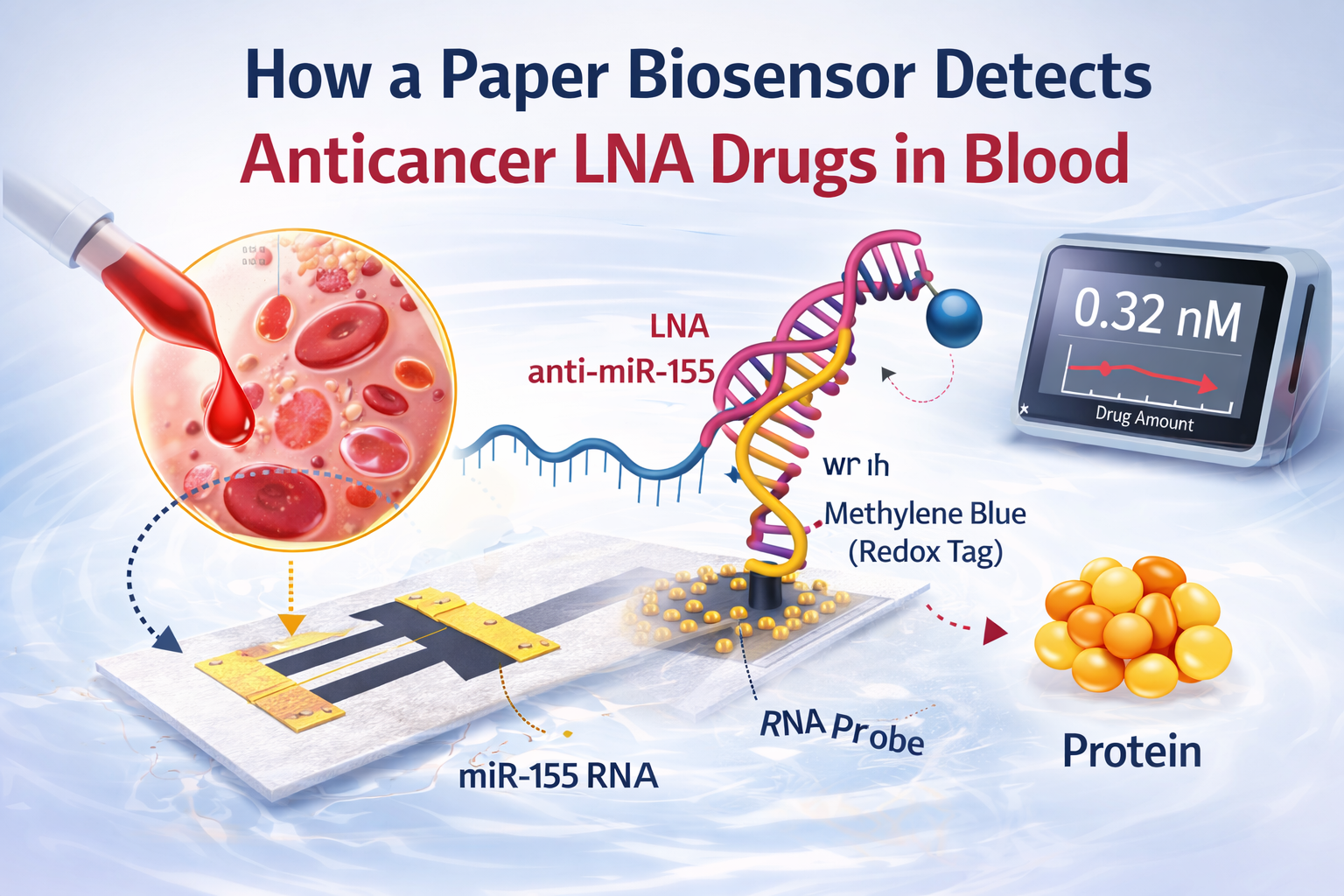
A recent study proposes an elegant solution: a disposable paper-based biosensor capable of detecting anticancer RNA drugs directly in human plasma.
To understand why this innovation matters, we first need to explore the biological players involved.
Understanding the Biology Behind the Study
What Are microRNAs (miRNAs)?
MicroRNAs are tiny RNA molecules (~22 nucleotides long) that regulate gene expression.
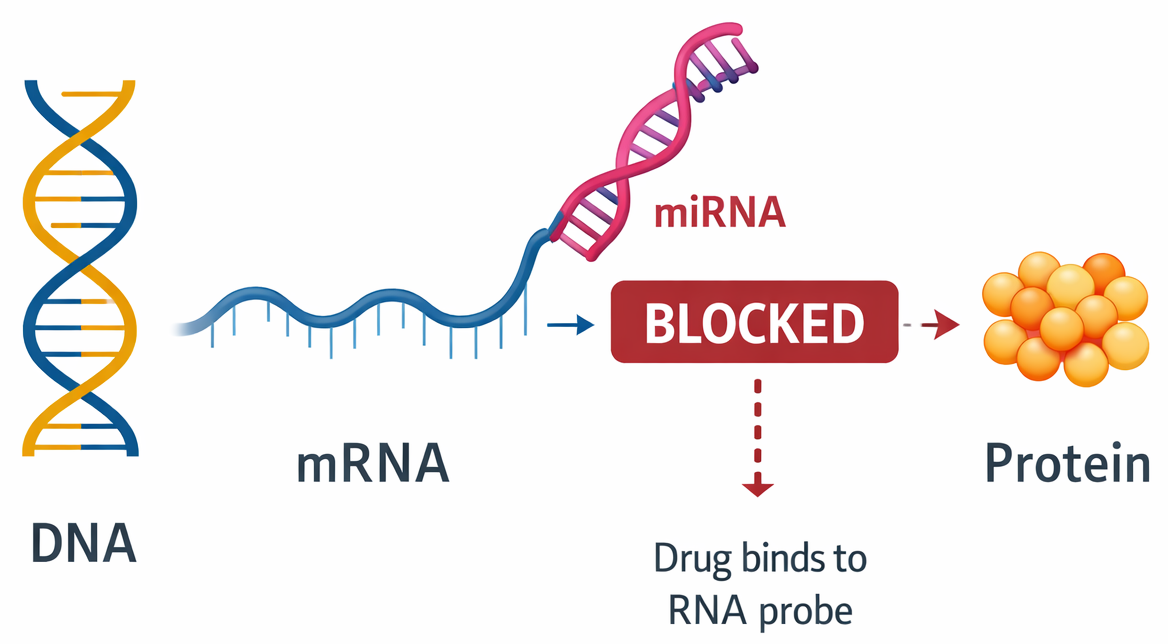
Unlike messenger RNA (mRNA), they do not produce proteins. Instead, they act as regulators that bind to mRNA molecules and prevent them from being translated into proteins.
In simple terms:
Because miRNAs control protein production, they influence many biological processes such as:
cell growth
immune response
- apoptosis (programmed cell death)
When miRNAs Contribute to Cancer
Some miRNAs become overactive in cancer. These are known as oncogenic miRNAs, or oncomiRs.
Instead of protecting cells, they silence important tumor-suppressor genes.
One well-known example is miR-155, which is linked to several cancers including:
lymphoma
leukemia
breast cancer
When miR-155 levels increase, cells may begin to grow uncontrollably.
Scientists therefore began exploring ways to block harmful miRNAs.
Enter LNA: A Powerful RNA-Targeting Technology
What Are Locked Nucleic Acids (LNA)?
Locked Nucleic Acids are chemically modified nucleotides designed to bind RNA very strongly.
In normal RNA molecules, the ribose sugar is flexible. In LNA molecules, a chemical bridge “locks” the sugar structure into a fixed shape.
This structural change provides several advantages:
| Property | Benefit |
|---|---|
| Higher binding affinity | Stronger interaction with DNA/RNA targets |
| Greater stability | Resistant to enzymatic degradation |
| Improved specificity | Better recognition of correct sequences |
Because of these properties, LNAs are widely used in antisense therapeutics, where short synthetic sequences are designed to block disease-causing RNA molecules.
The paper studies detection of an LNA inhibitor targeting miR-155, an oncogenic microRNA involved in cancer.
How LNA Drugs Work in Cancer Therapy
LNA molecules can be designed as anti-miRNA drugs.
Their job is simple: bind to harmful miRNAs and prevent them from functioning.
Simplified mechanism
Cancer cells produce excessive miR-155
miR-155 suppresses tumor-suppressor genes
An LNA anti-miR-155 drug binds to miR-155
The miRNA becomes inactive
Normal gene regulation is restored
This strategy is being explored in several clinical studies.
One well-known therapeutic candidate is Cobomarsen, an LNA inhibitor targeting miR-155.
The Hidden Challenge: Monitoring RNA Drugs
Developing RNA drugs is only half the battle.
Doctors also need to know:
how much drug is circulating in the bloodstream
whether the dose is effective
how quickly the drug is cleared from the body
This information is part of pharmacokinetics, the study of how drugs behave inside the body.
Currently, measuring nucleic acid drugs typically requires:
liquid chromatography–mass spectrometry (LC-MS)
HPLC
PCR-based techniques
These approaches are accurate but have important limitations:
expensive equipment
specialized laboratories
long analysis times
This makes rapid bedside monitoring difficult.
The Innovation: A Paper-Based Biosensor
The researchers developed a paper-based electrochemical sensor capable of detecting LNA drugs in human plasma.
Think of it as a diagnostic strip that produces an interpretable electrical signal when the target drug is present.
How the Sensor Works
The device uses a clever molecular design.
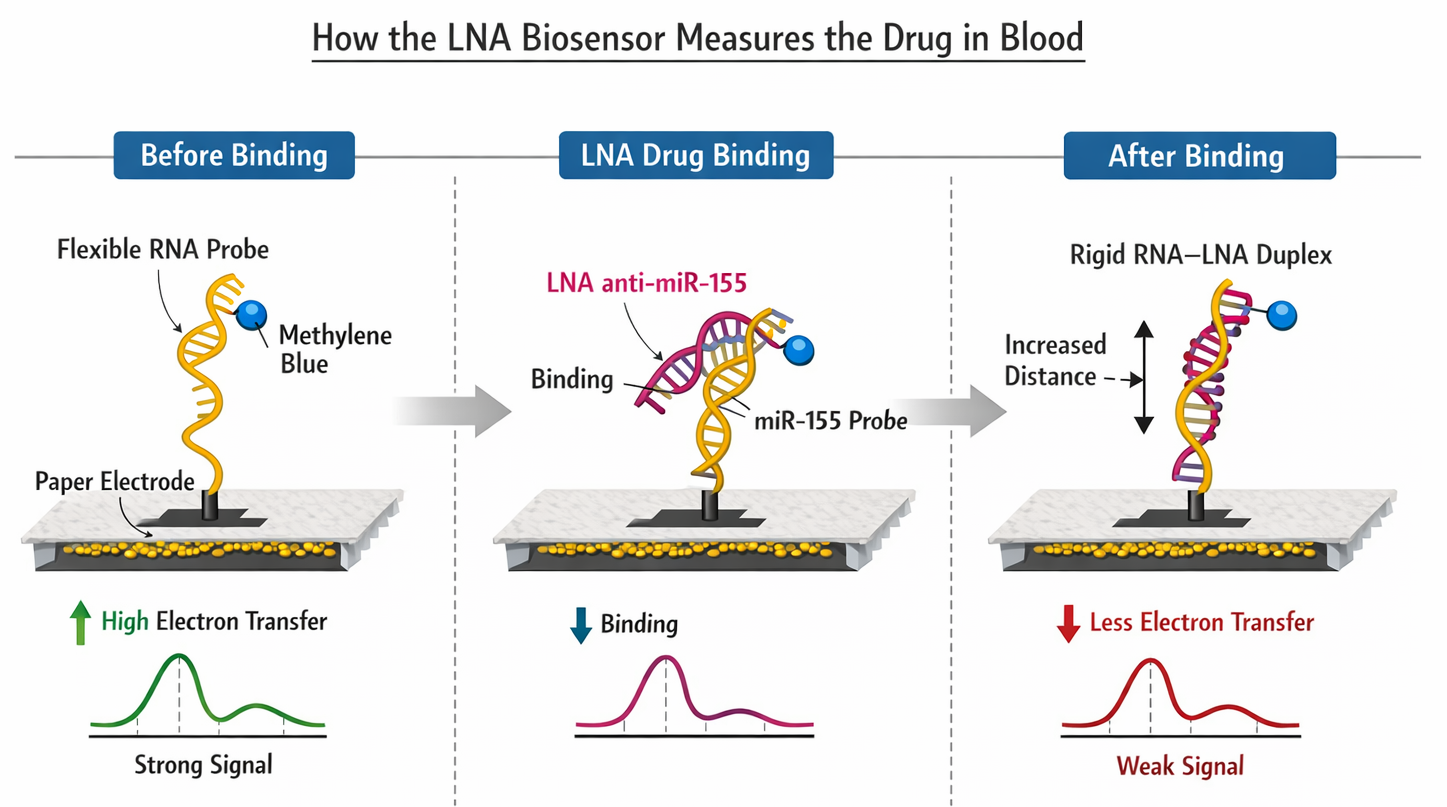
Step 1 — RNA Probe on a Paper Electrode
A short RNA sequence that mimics miR-155 is attached to a gold nanoparticle-modified electrode printed on paper.
The probe is also labeled with a redox molecule called methylene blue, which can generate an electrical signal.
Step 2 — Signal Generation
When no target drug is present:
the RNA probe remains flexible
the redox molecule stays close to the electrode
electron transfer occurs easily
This produces a strong electrical current.
Step 3 — Drug Detection
When the LNA anti-miR-155 drug is present:
it binds to the RNA probe
a rigid RNA–LNA duplex forms
the redox molecule moves away from the electrode
As a result, electron transfer decreases and the electrical signal drops.
The decrease in current directly reflects the concentration of the drug in the sample.
Why LNA Improves the Sensor Signal
LNA molecules form very stable and rigid duplexes with RNA sequences.
This rigidity creates a larger structural change in the probe when the drug binds.
The result is a clearer electrochemical signal change, making detection easier.
The researchers confirmed that LNA targets produce stronger signal changes compared with regular RNA targets.
Key Performance of the Device
The biosensor showed promising analytical results.
Detection Range
0.01 nM – 1000 nM
Limit of Detection
| Sample Type | Detection Limit |
| Buffer | 40 pM |
| Human plasma | 300 pM |
Importantly, the sensor works in undiluted human plasma, which is challenging because biological fluids contain many interfering molecules.
Despite this, the device maintained reliable detection.
Why Paper-Based Sensors Are Exciting
Paper-based biosensors are gaining attention because they offer several advantages:
extremely low manufacturing cost
portability
disposable design
minimal sample requirement
These characteristics make them ideal for point-of-care diagnostics.
Why Measuring LNA Drugs Matters
Being able to quickly measure RNA drugs in blood could transform several aspects of medicine.
Personalized cancer therapy
Doctors could adjust drug dosage based on measured blood concentrations.
Pharmacokinetic studies
Researchers could track how RNA drugs move through the body.
Faster clinical decisions
Portable sensors could enable rapid measurements without sending samples to specialized laboratories.
Supporting the rise of RNA medicine
RNA therapeutics—including antisense oligonucleotides and siRNA drugs—are rapidly expanding. Reliable monitoring tools will become increasingly important.
Limitations to Consider
While the results are promising, several challenges remain before such devices can be widely used in clinics.
For example:
testing in real patient samples
long-term stability of paper electrodes
integration into portable diagnostic systems
Further studies will be needed to address these issues.
The Scientific Way Forward
This research represents an intersection of multiple disciplines:
molecular biology
RNA therapeutics
nanomaterials
electrochemical biosensing
It demonstrates how fundamental molecular properties—such as the strong binding of LNA to RNA—can be used to design practical diagnostic technologies.
Research Paper Decoded Takeaway
This study demonstrates a low-cost paper-based electrochemical sensor capable of detecting anticancer LNA drugs directly in human plasma.
By exploiting the strong binding between LNA molecules and RNA probes, the device converts a molecular interaction into an electrical signal that can be easily measured.
As RNA-based therapeutics continue to grow, innovations like this may help enable rapid monitoring of nucleic acid drugs and support the development of personalized cancer treatments.
For Students:
As RNA-based medicines continue to grow, technologies that allow simple monitoring of these drugs may become as routine as glucose testing today.
What do you think about this approach?
As RNA-based therapeutics continue to expand, simple tools to monitor these drugs in patients could become increasingly important. Do you think paper-based biosensors like this could eventually be used in hospitals for routine drug monitoring? Share your thoughts or questions in the comments—we would love to hear how you see this technology evolving.

Editor, Research Paper Decoded