
Can PCR Leave the Lab? Find what the Dragonfly Portable mpox Diagnostic Platform Offer
What does a molecular diagnostics laboratory actually look like?
Most of us imagine large machines, extraction systems, refrigerators, pipettes, and PCR instruments sitting inside carefully controlled laboratory spaces.
Now imagine fitting much of that into a backpack.
That is essentially what researchers attempted with Dragonfly, a portable point-of-care molecular diagnostic platform designed for rapid detection of mpox (MPXV) and other skin-associated viral infections. But this paper is not simply about building another portable test.
Original Article Title: Portable molecular diagnostic platform for rapid point-of-care detection of mpox and other diseases
Journal: Nature Communications (2025)
DOI: https://doi.org/10.1038/s41467-025-57647-3
It asks a more interesting question:
Can molecular diagnostics finally leave the laboratory?
Because during disease outbreaks, the problem is often not amplification. It is everything surrounding amplification.
During the recent resurgence of mpox, delayed diagnosis and centralized testing repeatedly created bottlenecks in surveillance and outbreak response. Molecular methods like PCR already possess remarkable sensitivity. Yet sample collection, extraction, reagent handling, instrumentation, and transportation continue to slow real-world diagnosis.
Dragonfly attempts to redesign that entire workflow.
Not just the assay. Everything.
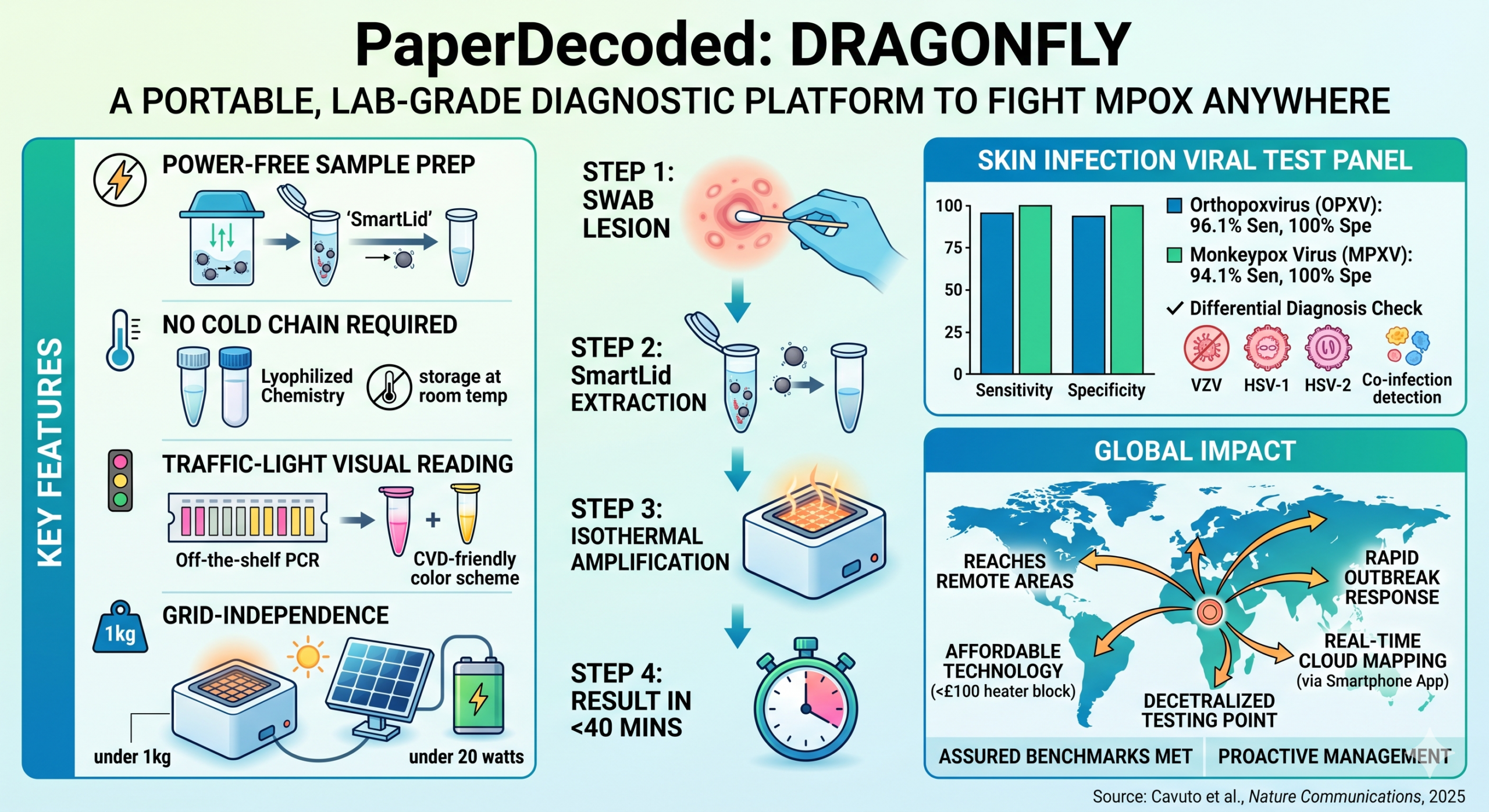
Why Point-of-Care Molecular Diagnostics Matter
Outbreaks rarely begin in places with ideal infrastructure.
Patients arrive with symptoms. Samples are collected. Specimens travel to centralized laboratories. Results return days later.
Meanwhile, transmission continues.
For diseases like mpox, rapid diagnosis matters not only for patient care but also for outbreak containment, contact tracing, and surveillance. The World Health Organization has increasingly emphasized the need for decentralized diagnostic solutions capable of functioning in resource-limited environments.
Traditional qPCR remains the gold standard, but most systems still require:
- cold-chain logistics,
- complex instruments,
- trained personnel,
- and controlled laboratory environments.
Dragonfly was built to challenge those assumptions.
The Cleverest Part Of The Paper Might Not Be LAMP
Interestingly, the most elegant idea here may not be the amplification chemistry.
It involves a lid.
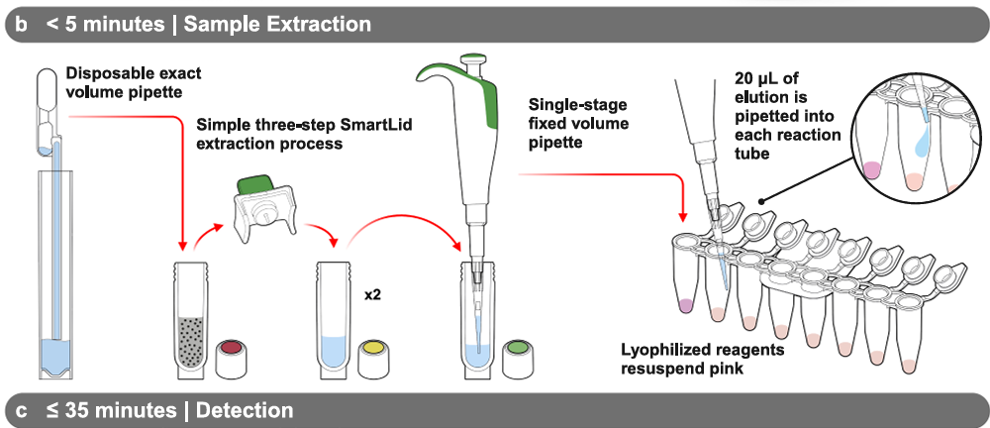
Researchers developed SmartLid, a magnetic cap designed to transport magnetic beads carrying nucleic acids between extraction stages. Instead of relying on repeated pipetting or centrifugation, nucleic acids simply move through three extraction steps:
- Binding,
- Washing,
- Elution.
The entire extraction process requires less than five minutes and operates without electrical instruments.
Researchers familiar with molecular workflows may immediately recognize why this matters.
Extraction frequently becomes the hidden bottleneck of point-of-care diagnostics.
Dragonfly quietly turns it into one of the paper’s most interesting engineering solutions.
Building A Molecular Workflow Around Humans
One surprisingly thoughtful aspect of Dragonfly is that researchers designed around usability rather than laboratory habits.
Extraction tubes follow a simple traffic-light arrangement:
- Red.
- Yellow.
- Green.
The packaging itself unfolds into a workstation that guides users through the process. That may sound like a minor design choice. It is not.
Point-of-care systems often fail because of workflow complexity rather than chemistry.
For field deployment, simplicity itself becomes engineering.
Freeze-Dried Molecular Biology Changes The Equation
Portable workflows face another challenge: reagents do not travel well.
Traditional molecular assays often depend on refrigeration and cold-chain transport. Maintaining stability becomes expensive and difficult during field deployment.
Dragonfly instead uses lyophilized colorimetric LAMP chemistry, allowing room-temperature storage and transportation.
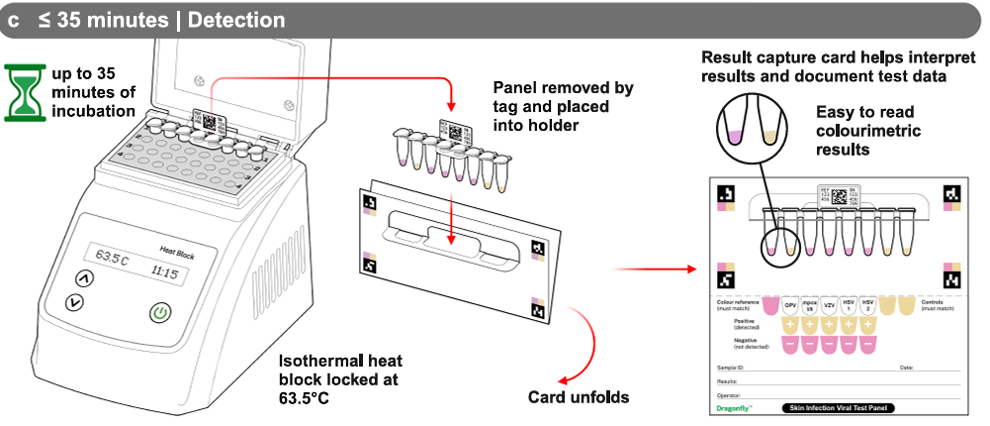
Positive reactions shift from pink to yellow through pH changes generated during amplification. This removes the need for expensive fluorescence optics and enables visual interpretation.
A surprisingly simple solution.
But one with major practical implications.
This is Not Just A mpox Test
Skin lesions can be deceptive.
Mpox, herpes infections, and varicella-zoster infections can produce remarkably similar presentations. Visual diagnosis alone frequently becomes difficult. Researchers therefore avoided creating a single-target assay.
Instead, Dragonfly was designed as a multi-pathogen skin infection panel detecting:
Orthopoxvirus, Mpox virus, HSV-1, HSV-2, and Varicella-zoster virus.
That subtle decision transforms Dragonfly from a detection system into a differential diagnostic platform. Finding a pathogen matters.
Distinguishing among several clinically similar pathogens matters even more.
Clinical Validation of Dragonfly
Eventually every diagnostic paper faces the same question:
Does it work outside the laboratory?
Researchers evaluated Dragonfly using 164 clinical lesion samples, including 51 confirmed mpox-positive specimens, and compared performance against conventional extraction and qPCR workflows.
Performance was surprisingly strong.
Dragonfly achieved:
96.1% sensitivity and 100% specificity for Orthopoxvirus detection and 94.1% sensitivity with 100% specificity for Mpox detection.
The platform also demonstrated an analytical limit of detection around 100 genome copies per reaction, approaching laboratory-grade molecular sensitivity.
Most false negatives occurred in samples with very high Ct values and extremely low viral loads.
Even traditional molecular assays frequently struggle in that range.
How Dragonfly Compares With Existing Point-of-Care Molecular Tests
Many near-patient molecular platforms still rely on cartridge systems, optical readers, and sophisticated instrumentation.
Dragonfly takes a different approach.
Rather than increasing automation complexity, it reduces hardware dependence.
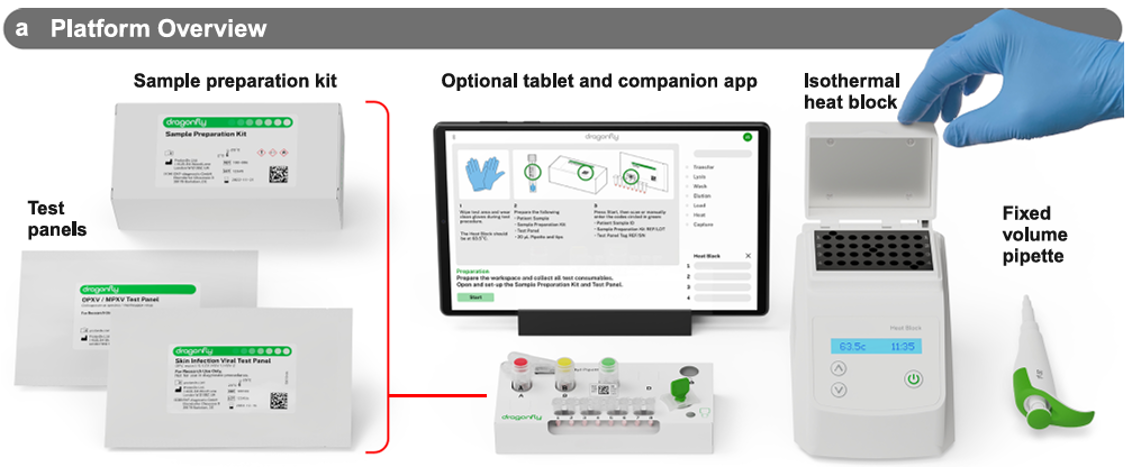
The platform requires little more than a portable heat block, simplified extraction workflow, and visual interpretation. Researchers estimate even the heating component could be manufactured for under £100.
That distinction may become especially important for low-resource environments and outbreak deployment.
Research Paper Decoded Quick Take
Most molecular diagnostic papers attempt to improve amplification chemistry. Dragonfly attempted something different. It improved experience. Because amplification may never have been the largest problem.
The future of molecular diagnostics may not simply involve better enzymes or more sensitive assays. It may involve making molecular biology portable enough to reach where disease actually begins.
Dragonfly does not completely solve that challenge. But it suggests molecular diagnostics may finally be learning how to travel.
The Graphical Work Flow of Dragonfly

Editor, Research Paper Decoded