
Some scientific mysteries survive for decades because they look too ordinary to question.
The heart pumps blood nonstop. Every day, millions of circulating cancer cells travel through it. The myocardium is richly vascularized. By all logic, the heart should be a welcoming destination for metastasis.
Yet it is not.
Primary cardiac tumors are extremely rare. Even cardiac metastasis, despite constant blood flow and extensive vascularization, occurs far less often than expected. This mysterious phenomenon has fascinated researchers studying heart cancer resistance for decades.
Is the heart actively defending itself against cancer?
Not using immune cells. Not using secreted toxins. But using something much simpler: Its mechanical force.
This paper asks a beautifully unconventional question: Can the physical act of beating suppress cancer itself? More broadly, can principles of cancer mechanobiology explain why the heart appears naturally resistant to tumor growth?
Why is cancer rare in the heart?
Researchers found that the heart’s continuous mechanical force may actively suppress cancer growth. A recent Science study suggests that mechanical load alters chromatin structure through mechanotransduction pathways involving Nesprin-2, helping explain heart cancer resistance and the rarity of cardiac metastasis.
Original Article: Mechanical load inhibits cancer growth in mouse and human hearts
DOI: https://doi.org/10.1126/science.ads9412
Journal: Science (23 Apr 2026)

The detective story begins
The authors noticed another biological mystery. Adult heart cells almost never divide. Unlike skin or intestinal cells, cardiomyocytes stop proliferating early in life. Previous studies suggested that one reason may be the sudden increase in mechanical load after birth.
As newborn circulation matures, the heart begins experiencing stronger pressure and contraction forces resulting in increased mechanical load on cardiac tissue. More mechanical load leads to less proliferation—an observation that forms the foundation of the paper’s mechanical load cancer hypothesis.
If mechanical stress stops heart-cell growth, maybe it can stop cancer-cell growth too.
This logic is elegant because cancer and regeneration are two sides of the same coin: Both require cells to divide. Suppress one mechanism and perhaps both are affected.
Chapter 1: First prove that the heart is truly cancer resistant
The team used mice engineered with two classic oncogenic alterations:
- activated mutant K-Ras
- deleted p53 tumor suppressor
This combination is like giving cells a complete “become cancer now” instruction set.
The virus (the delivery vehicle that activates cancer-causing mutations) reached liver, skeletal muscle, and heart with similar efficiency. Yet cancers emerged elsewhere and never in the heart.
This result sounds simple, but scientifically it was essential. Because before asking why the heart resists cancer and cardiac metastasis, they first had to prove the resistance was real.
Critical interpretation
The authors intentionally removed an alternative explanation: Maybe the heart simply wasn’t infected, maybe recombination failed, maybe delivery was poor.
No.
Cancer-driving mutations happened. Yet tumors still did not arise. That strengthens the hypothesis dramatically.
Chapter 2: What if we silence the heartbeat’s force?
Now comes one of the most clever experiments in the paper.
The investigators surgically transplanted mouse hearts into the neck region using a heterotopic heart transplantation model.
Blood still perfused the transplanted organ. But mechanical loading inside the ventricle almost disappeared.
The heart was alive. But mechanically “lazy.” Then they injected lung cancer cells.
Result:
Loaded hearts resisted tumor growth. Unloaded hearts became overrun with cancer. Not slightly. Massively.
Why this experiment matters
A weaker paper would simply compare beating vs non-beating tissues. But beating changes many things:
- blood flow
- oxygen
- nutrients
- inflammation
In many ways, this became a clean experiment in cancer mechanobiology, allowing the researchers to isolate how physical force alone influences tumor behavior. That is important experimental design. They isolated force itself.
Another critical checkpoint
Large tumors can arise for several reasons:
- Better initial cell attachment
- Reduced cell death
- Increased proliferation
The authors systematically checked each possibility.
- Initial cancer cell numbers were similar.
- Cell death markers remained unchanged.
- Only proliferation markers increased.
This step is often ignored in weaker studies. Without it, one could wrongly conclude mechanical force affects growth while it merely affects survival.
Chapter 3: Building miniature hearts in the lab
Mouse surgeries are powerful but complicated. So the team built engineered heart tissues (EHTs). Tiny beating cardiac tissues where mechanical load could be dialed up or down using adjustable braces.
Think of it as creating a gym machine for heart tissue, which is the source for mechanical load on the cardiac tissue.
The response of the cardiac tissue regard to the cardiac cancer against the planned regulation of the mechanical load on cardiac tissue observed and interpreted.
Unloading increased cancer proliferation. Higher load suppressed it. This effect of mechanical force on cancer tissue shown excellent reproducibility across different cancer systems is where the paper becomes convincing.
The strange observation nobody expected
Cancer cells avoided the center of beating tissues. Instead they accumulated near outer regions.
Why?
Mathematical simulations revealed that the center experienced greater compressive pressure during contraction. The beating tissue was physically squeezing cells. Cancer cells seemed to avoid areas with stronger mechanical stress.
The authors now faced another challenge
Could beating heart cells simply consume nutrients faster? Maybe cancer starved. That would be a boring explanation. So they tested it.
Media from beating and static tissues showed no meaningful difference. Glucose competition also failed to explain the effect. The authors systematically eliminated metabolism as the major cause. The culprit remained mechanical force. These findings strengthen the emerging idea that mechanical load cancer interactions may shape tumor behavior independently of genetics and metabolism.
Chapter 4: The heart leaves fingerprints on cancer cells
Now the story shifts from physiology to epigenetics. The team analyzed human cardiac metastases and compared them with metastases elsewhere in the same patients.
Surprisingly, cardiac metastases shared a common molecular profile regardless of tumor origin. Lung cancer. Colon cancer. Melanoma. Different cancers. Same cardiac signature.
That finding is powerful. Because it suggests the heart environment rewrites tumor behavior.
They discovered strong upregulation of histone demethylases.
This corresponded with:
- lower H3K9me3
- lower chromatin compaction
Here’s the biology hidden beneath the result
Chromatin behaves like a library. Tightly packed books: hard to access. Open shelves: Easy to read.
Mechanical forces changed how cancer packaged its DNA. And this packaging altered access to genes controlling proliferation.
One subtle point deserves attention
Many readers may think:
Reduced chromatin compaction should activate proliferation. But the paper argues something more nuanced.
Mechanical stress opened chromatin specifically at regions linked to:
- mechanosensing
- cell cycle arrest
- external sensing pathways
So chromatin opening itself was not the message. Which genes opened mattered. That distinction is crucial.
Chapter 5: Meet Nesprin-2 — the molecular shock absorber
Cells cannot directly understand force. Somewhere a molecular translator must convert physical pressure into biological language.
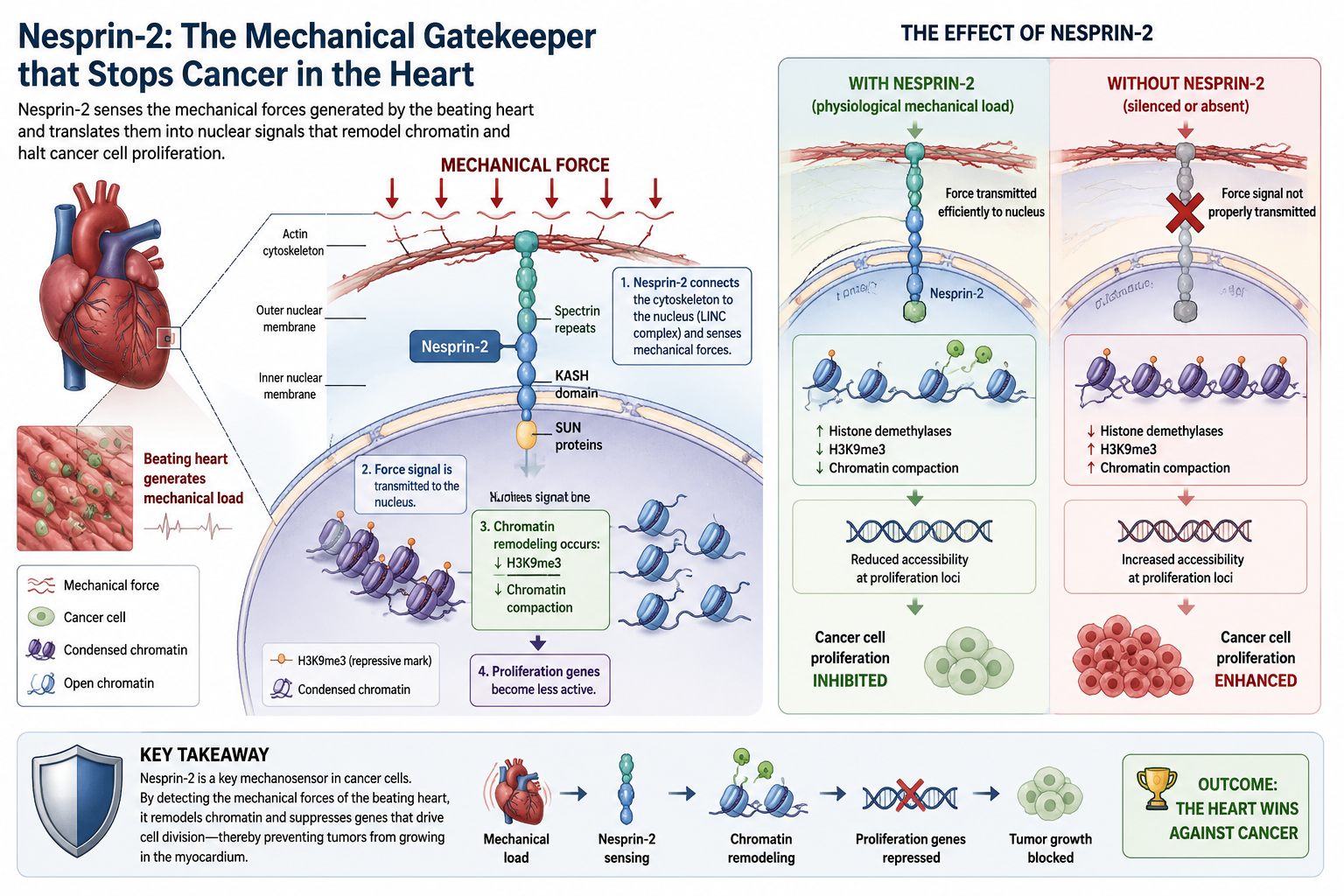
The authors focused on the LINC complex—a molecular bridge connecting the cytoskeleton to the nucleus and one of the most important systems involved in cellular mechanotransduction. Among its members one protein stood out: Nesprin-2.
When Nesprin-2 was silenced: Cancer cells ignored mechanical signals.
They proliferated aggressively inside beating tissues and even in living hearts.
This experiment is the paper’s strongest mechanistic evidence.
Mechanical force → sensed through Nesprin-2 → chromatin remodeling → reduced proliferation
Break Nesprin-2. Break the defense system. In other words, mechanotransduction was not merely associated with heart cancer resistance—it appeared central to it involving a series of molecular events.
Critical evaluation
This is the strongest mechanistic evidence in the paper. But one caution remains. Nesprin-2 likely isn’t acting alone. Mechanical signaling networks involve:
- YAP/TAZ
- Piezo channels
- cytoskeletal remodeling
- nuclear lamina interactions
The authors acknowledge broader mechanosensing pathways may contribute. Future work will probably uncover additional players.
Bigger Than Cardiology
Recent work in cancer mechanobiology suggests tumors respond not only to genes and drugs, but also to physical forces such as stiffness, pressure, and compression. This raises a fascinating possibility: could mechanical environments someday become therapeutic tools? What’s your thought?
PaperDecoded Quick Take
For decades people asked: Why doesn’t cancer like the heart?
This paper proposes an answer that feels almost poetic: The heart does not merely pump blood. It continuously presses, stretches, and mechanically interrogates every cell inside it.
Cancer entering the myocardium faces a world in constant motion. And every heartbeat whispers: You are not allowed to grow here.
Perhaps one day cancer therapy may not only involve drugs and genes— but engineered mechanical environments. The future possibility is striking: Instead of poisoning tumors, we may someday physically convince them not to divide.
Paper: Mechanical load inhibits cancer growth in mouse and human hearts

Editor, Research Paper Decoded