
AI can now support almost every stage of academic research—from finding papers to preparing for peer review. This article explores practical tools for literature search, paper reading, evidence checking, data analysis, scientific writing, and reference checking. It also shows how AI can simulate reviewers and help identify weaknesses before submission. The central message is simple: let AI handle the routine work, while researchers remain responsible for scientific thinking and judgment.
AI Tools Every Researcher Should Try: From Finding a Paper to Surviving Peer Review
Research is exciting. You get an idea which create curious question. Then you start searching for literature around your curiosity and then you face the reality. There are hundreds—or sometimes thousands—of papers to read. Important information is hidden inside tables. One paper agrees with another, while the third says exactly the opposite. You open one PDF, then another, then another and goes on.
Before you know it, half of your day has disappeared. And you haven’t even started your experiment.
Then comes the data, the graphs and their analysis. Then the manuscript, proper referencing, journal formatting. And finally, the most frightening part: Peer review.
What if AI could help at every one of these stages? Not writing your entire research work for you. Not replacing your scientific thinking. But acting like a small team of assistants sitting beside you. One assisting to find literature for you while another helps you to understand them. Some checks whether a claim is actually supported while some helps with data. Another improves your writing and while some AI tools plays the role of a very annoying reviewer who keeps asking “But why?”
This article is about building exactly that kind of AI-assisted research workflow which will improve the overall research output whether you are a PhD students, Post Doctoral fellow or a Scientist in academic research field.
To understand how these tools can work together, let’s imagine that we are studying a simple question:
Does regular exercise improve sleep quality in adults?
This is not our research project. It is simply a common example that allows us to walk through the research workflow with assistance from AI platforms. Now imagine that we want to investigate this question properly. Where should we begin and how should we approach the research question.
Step 1: Finding the Right Papers.
Try: Elicit
The first problem with research is usually not a lack of information. It is too much information. Search for “exercise and sleep” in a traditional search engine and you can quickly find an overwhelming number of results.
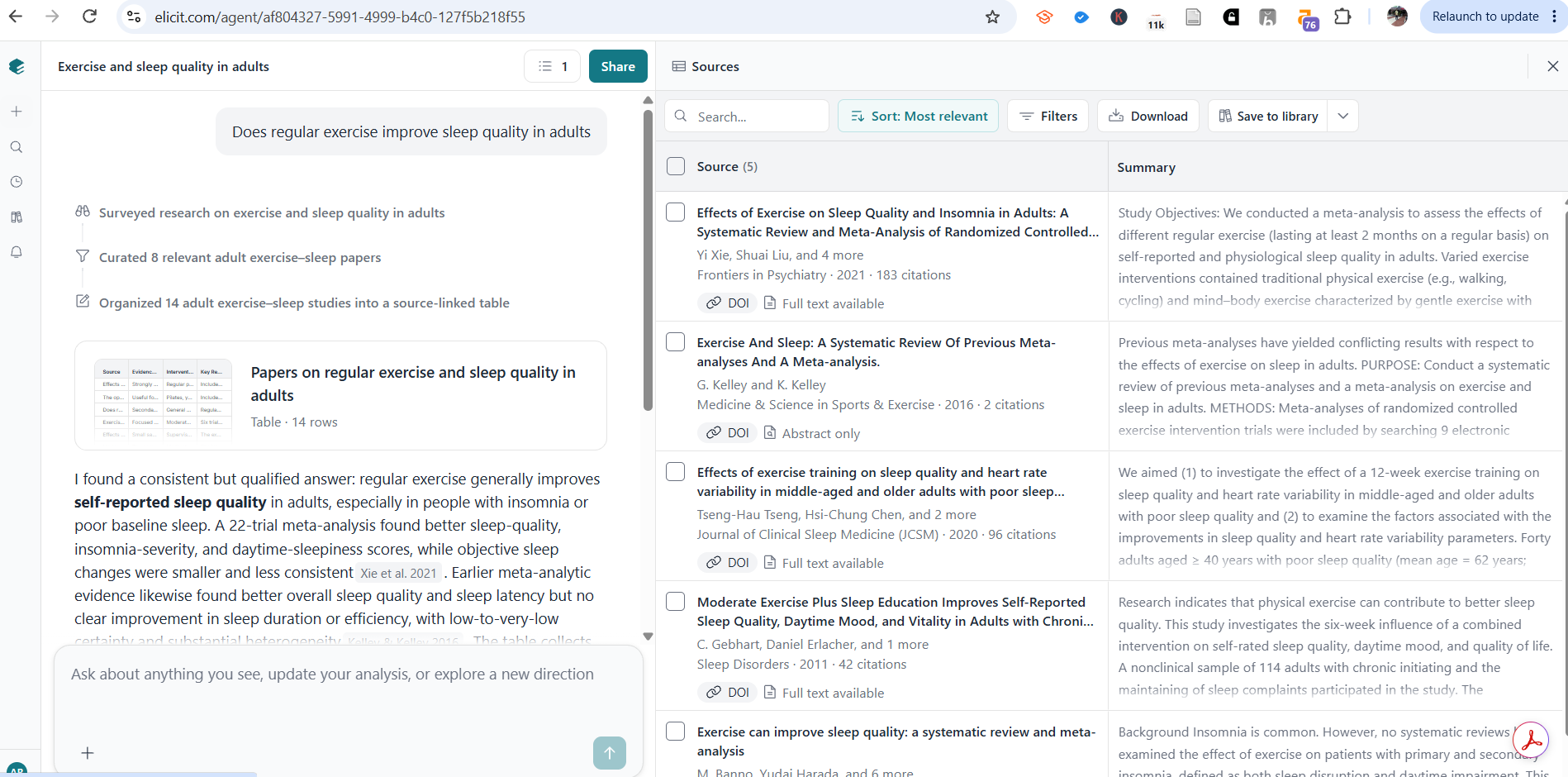
Which papers matter? Which ones are actually relevant? Which studies used humans? Is there any study that found an improvement? Which found no significant effect? This is where an AI literature tool such as Elicit can become useful.
Instead of thinking only in terms of keywords, you can give it a research question: “Does regular exercise improve sleep quality in adults?”
Elicit can help find relevant academic papers and organize information from them. Its current system supports literature search, screening, structured data extraction and research synthesis.
Now imagine getting a table like this:
| Study | Participants | Exercise | Duration | Sleep measure | Main finding |
|---|---|---|---|---|---|
| Study A | 120 | Walking | 12 weeks | Sleep score | Improved |
| Study B | 80 | Resistance training | 8 weeks | Sleep score | Improved |
| Study C | 200 | Mixed exercise | 6 months | Sleep quality | No clear effect |
Suddenly, the literature feels less like a giant library and more like something you can actually work with.
But don’t make this mistake
Never assume: “AI found it, therefore it must be correct.” The AI has helped us find and organize the evidence. We still need to check the important papers ourselves. Think of Elicit as your research librarian. It finds books relevant to your query.
You still need to read the important ones based on the relevant key findings.
Step 2: Discover Papers You Didn’t Know You Were Looking For
Try: ResearchRabbit, Connected Papers or Litmaps
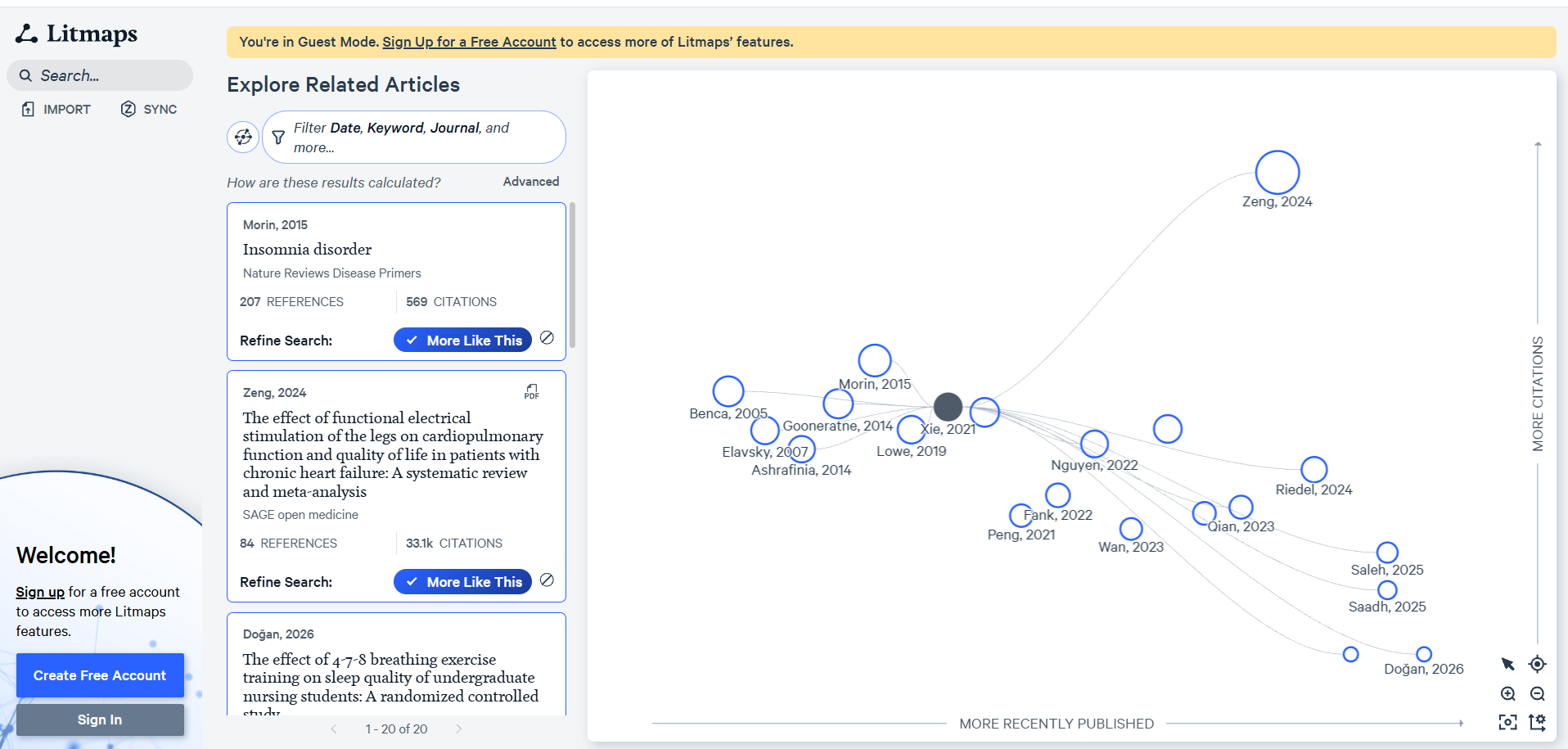
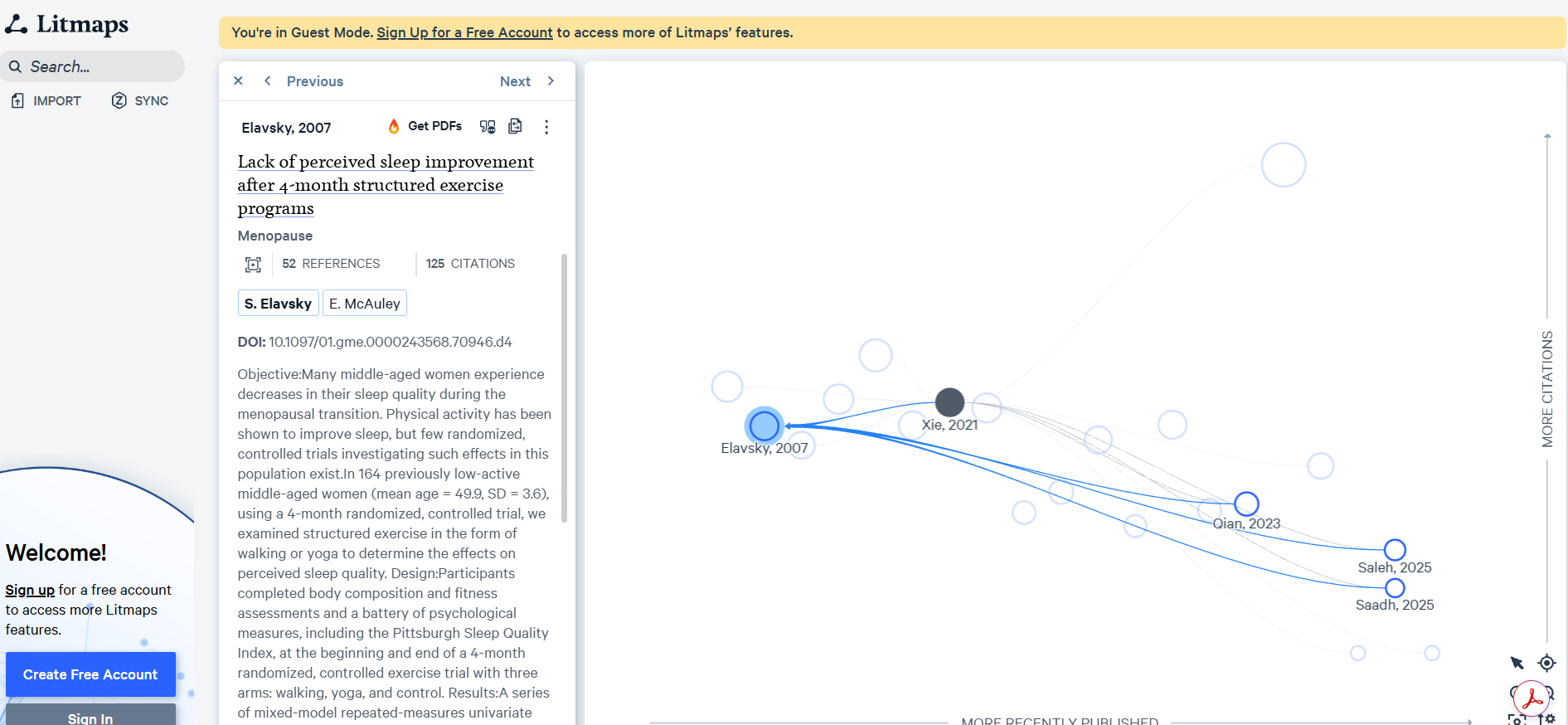
Sometimes the best paper is not the one you find through your search terms. It is the paper connected to the paper you just found. This is where citation-mapping tools become interesting. Imagine you find one excellent paper on exercise and sleep. Instead of stopping there, you can explore: Which papers did it cite? Who cited it later? Which researchers are working on the same question? Are there clusters of studies reaching different conclusions? This is like discovering a map hidden behind the literature. And sometimes that map is more useful than another keyword search.
Step 3: Don’t Just Find Supporting Papers
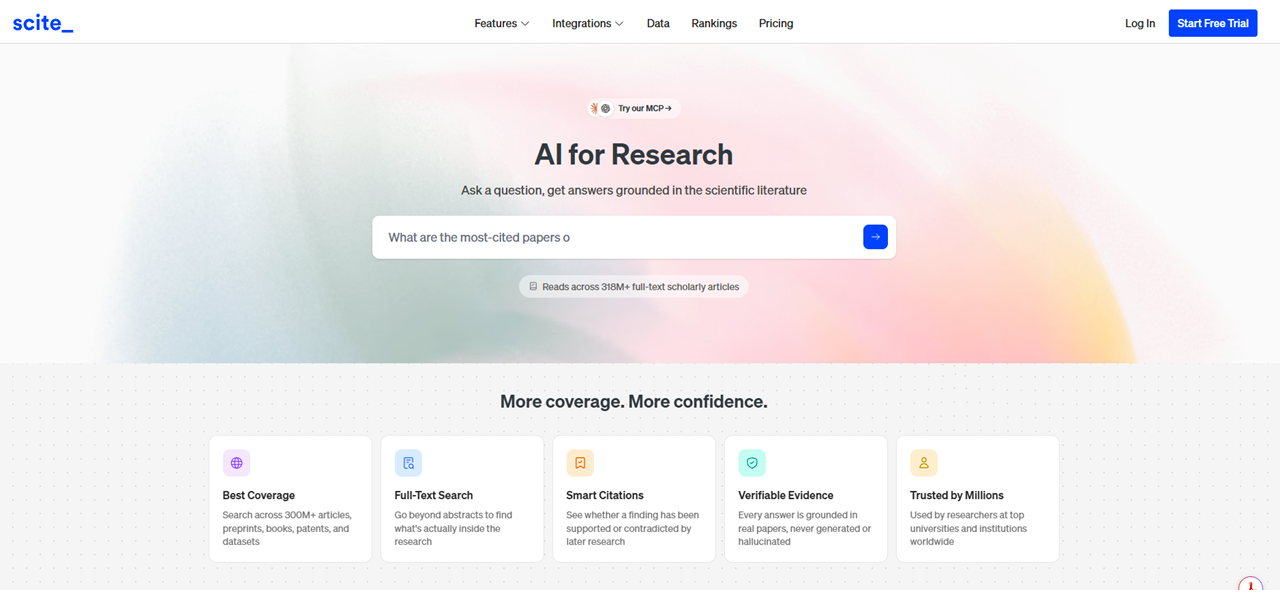
Try: Scite
Here’s a problem researchers face all the time. You find a paper supporting your argument. You planned to cite it. But what happened after that paper was published? Did later researchers agree? Did someone challenge the finding? Was the original result supported by subsequent studies? This is where Scite becomes particularly interesting.
Its Smart Citations are designed to show how later papers cite a study, including whether the citation context supports, contrasts with, or simply mentions the earlier work. Imagine you find a paper saying: “Exercise improves sleep quality.”
Before confidently repeating that sentence in your manuscript, you can investigate the citation trail. Perhaps ten later papers support the conclusion or five disagree. May be most research simply mention the original paper without testing the claim. That’s a very different picture.
This leads to one of the most useful habits you can develop with AI: Don’t ask only, “Can I find a paper supporting this?” Ask: “What happened to this claim after the paper was published?” That is a much more scientific question.
Step 4: Now Open the Difficult Paper
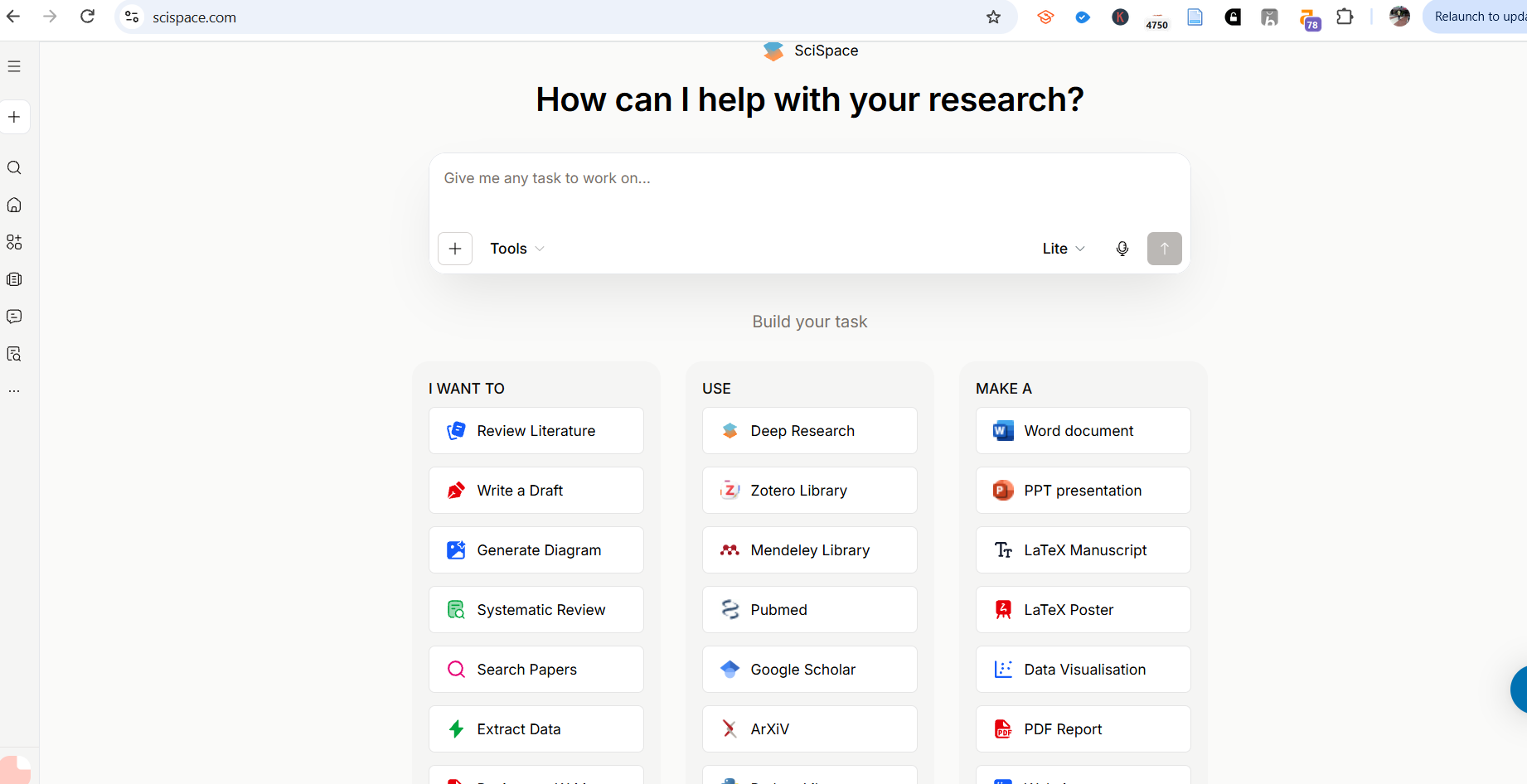
Try: SciSpace
Finding a paper is easy. Understanding it can be another story. Some papers seem to have been written specifically to make you read the same paragraph five times. There are complicated methods.
Long sentences. Unfamiliar terms. Dense tables. Figures that seem to contain an entire thesis. AI reading tools can help here. SciSpace provides AI-assisted tools for working with research papers and understanding their content.
But don’t just ask: “Summarize this paper.” That usually produces a nice paragraph that you forget five minutes later.
Instead, ask questions like:
- “What was the main research question?”
- “How was the experiment designed?”
- “What was the control group?”
- “What were the most important results?”
- “What are the weaknesses of this study?”
- “Which conclusion is directly supported by the data?”
That last question is particularly important. Because there is often a difference between: What the experiment showed and what the authors think the experiment means. A good researcher learns to separate the two. AI can help you do that faster.
Step 5: Turn Hundreds of Papers Into One Useful Table
Now comes one of the most fruitful but boring parts of literature research. Data extraction. Suppose we have 100 studies. We want to know: number of participants, type of exercise, study duration, age group, sleep measurement method, main result. Doing this manually can take a huge amount of time. AI can help extract these details into a structured table.
For example:
| Paper | Participants | Exercise | Duration | Measurement | Result |
|---|---|---|---|---|---|
| A | 120 | Walking | 12 weeks | Sleep scale | Improved |
| B | 80 | Resistance | 8 weeks | Sleep scale | Improved |
| C | 200 | Mixed | 6 months | Questionnaire | Unclear |
This is where AI becomes more than a chatbot. It becomes a data-entry assistant. But there is a catch. Suppose the paper says: “Participants exercised for 30 minutes, three times a week.”
AI might correctly extract the information. But it might also misunderstand: “30 minutes per session” as: “30 minutes per week.” One small mistake can contaminate an entire dataset. So the rule is simple:
Let AI do the first pass. Don’t let AI have the final word.
Check the important information against the original paper.
Step 6: Let AI Help You Explore the Data
Now we have a dataset. This is where tools such as ChatGPT or Claude, together with Python or R, can become extremely useful. Instead of manually calculating everything, you can ask AI to help you:
- clean the dataset
- identify missing values
- explore patterns
- generate graphs
- write analysis code
- explain statistical tests
- perform calculations
- create publication-ready visualizations
For example: “Show me whether study duration appears to be related to improvement in sleep quality”, Or: “Create a graph comparing the outcomes of different types of exercise.”
The important part is what happens after AI produces the result. Don’t simply copy the answer. Rather you can ask: “Why did you choose this statistical test?” Then check whether that choice actually makes sense.
AI can write excellent statistical code. It can also write confidently wrong statistical code. That’s why the researcher still needs to understand the analysis. So the logical data analysis strategy must be replicated using standard data analysis software instead of complete reliance on AI tools. AI should be treated as an assistant who helps you to fast your research. You scientific ethics and your scientific existence can not completely replaced with AI.
Step 7: Now Comes the Manuscript
Finally, we have something worth writing about. But writing a research paper is not simply putting sentences together. You need a story to tell about your research and its output. The reader needs to understand everything you faced during the journey of your project.
AI can help organize this story. Tools such as ChatGPT, Claude and academic writing platforms can help with:
- improving sentence structure
- making paragraphs clearer
- reducing repetition
- improving transitions
- explaining complicated ideas more simply
- improving academic language
And tools such as Paperpal are specifically designed around academic writing and manuscript preparation. But there is an important difference between:
“AI wrote my paper.” and “AI helped me communicate my research better.”
The second is the healthier approach. Your results should come from your research. Your interpretation should come from your scientific judgment. AI should help you communicate them clearly.
Step 8: Ask AI to Check Your References
Now let’s do something many researchers don’t do often enough. Take an important sentence from your manuscript: “Previous studies have shown that exercise improves sleep quality.” Now ask:
Does my citation actually support this statement?
This is where tools such as Scite can help investigate the citation context. You can also ask an AI assistant to identify statements in your manuscript that appear to need citations. For example: “Find every factual claim in this Discussion that should probably have a citation.”
Then investigate them one by one. This can uncover surprisingly weak parts of a manuscript. Sometimes the problem isn’t that the sentence is false. The problem is that you haven’t provided enough evidence for it.
Step 9: Give Your Paper to a Very Unfriendly Reviewer
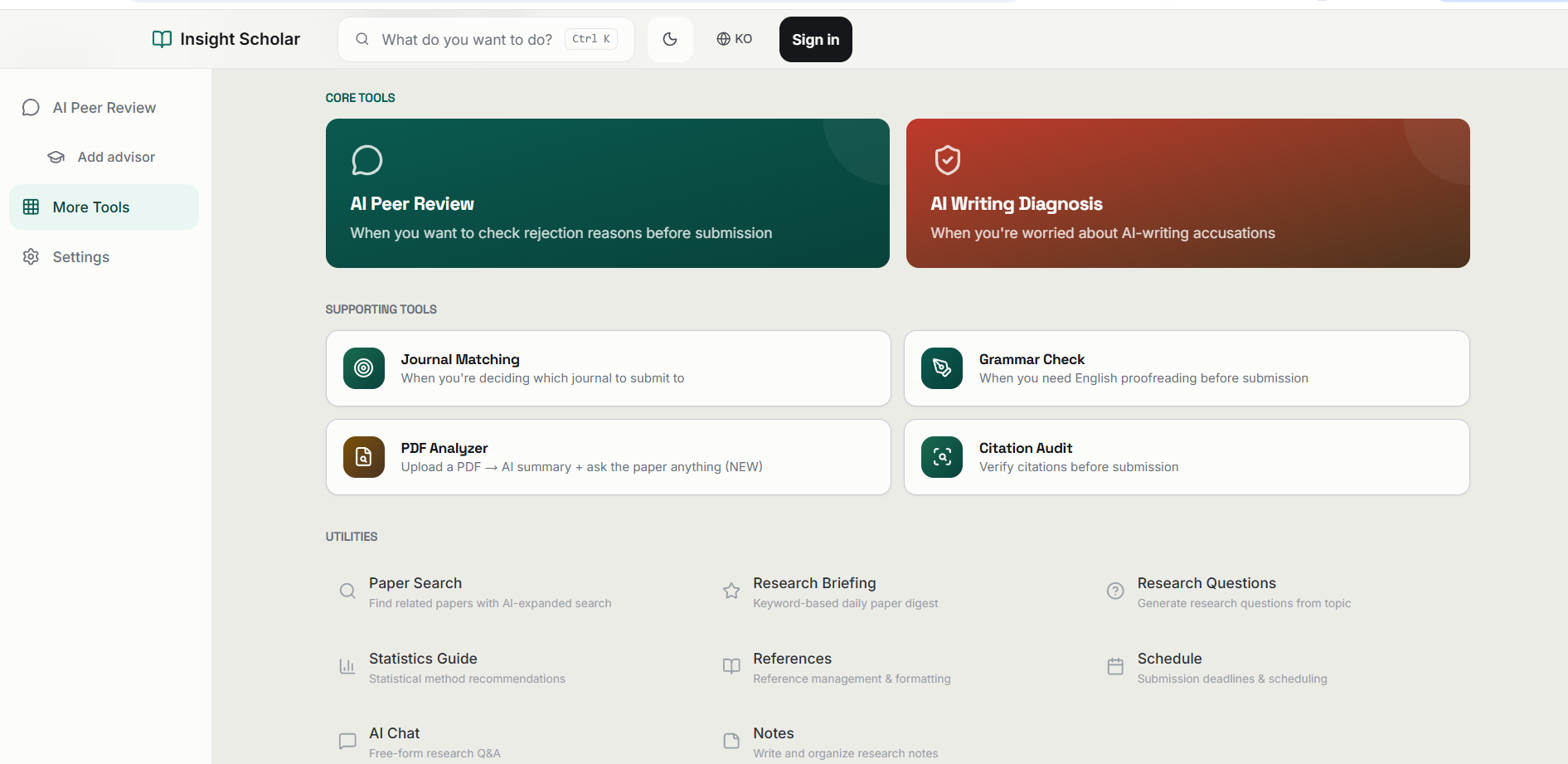
Try: Insight Scholar
Now we reach the fun part. Imagine submitting your manuscript. A few weeks later, Reviewer #2 opens it. You know what happens next.
- “The authors have not adequately explained…”
- “The sample size appears…”
- “The novelty of this work is unclear…”
- “The authors should provide…”
Every researcher knows the feeling. So why not experience some of that pain before submitting? Give your manuscript to an AI and say:
“Act as a highly critical peer reviewer. Do not praise my paper unnecessarily. Look for reasons why this manuscript could be rejected.”
Now ask it to examine:
- Scientific question: Is the question important?
- Novelty: What is genuinely new?
- Experimental design: Are the experiments sufficient?
- Controls: Are the controls appropriate?
- Statistics: Are the statistical methods justified?
- Results: Do the results support the conclusions?
- Discussion: Are the authors making claims stronger than the evidence allows?
- References: Are important studies missing?
- Reproducibility: Could another researcher repeat the work?
This is where AI can become surprisingly useful. Not because it is a real peer reviewer. But because it can force you to look at your own work from another perspective.
Step 10: Create Three AI Reviewers
Why stop at one? Create three different reviewers.
Reviewer 1: The Scientist
Ask: “Focus on scientific reasoning, experimental design and novelty.”
Reviewer 2: The Statistician
Ask: “Focus only on data quality, statistical methods, sample size and interpretation.”
Reviewer 3: The Skeptic
Ask: “Assume you don’t believe the main conclusion. Find every weakness that could undermine it.”
Now compare the three reports. If all three reviewers identify the same problem, pay attention. You may have found a real weakness.
Step 11: And Then Become the Editor
Peer reviewers aren’t the only people who can stop your paper. The editor can do it first. Ask AI to act as the editor of your target journal.
Give it: the manuscript, journal aims and scope, author guidelines, abstract, cover letter Then ask:
“Would you send this manuscript for peer review, or would you reject it at the editorial stage? Explain why.”
This creates a different kind of test. The reviewer asks: “Is this scientifically convincing?”
The editor asks: “Does this belong in my journal, and is it ready for review?”
Both questions matter to finally published in a reputed scientific journal.
Step 12: Run the Paper Through a Pre-Submission Check
This is where specialized academic platforms can help. Paperpal, for example, provides manuscript checking and pre-submission support covering language and a range of technical and submission-related issues. This is useful for catching problems such as:
- inconsistent terminology
- reference issues
- formatting problems
- missing sections
- figure/table issues
- language problems
- journal-specific requirements
Think of this as the final inspection before your manuscript leaves the laboratory.
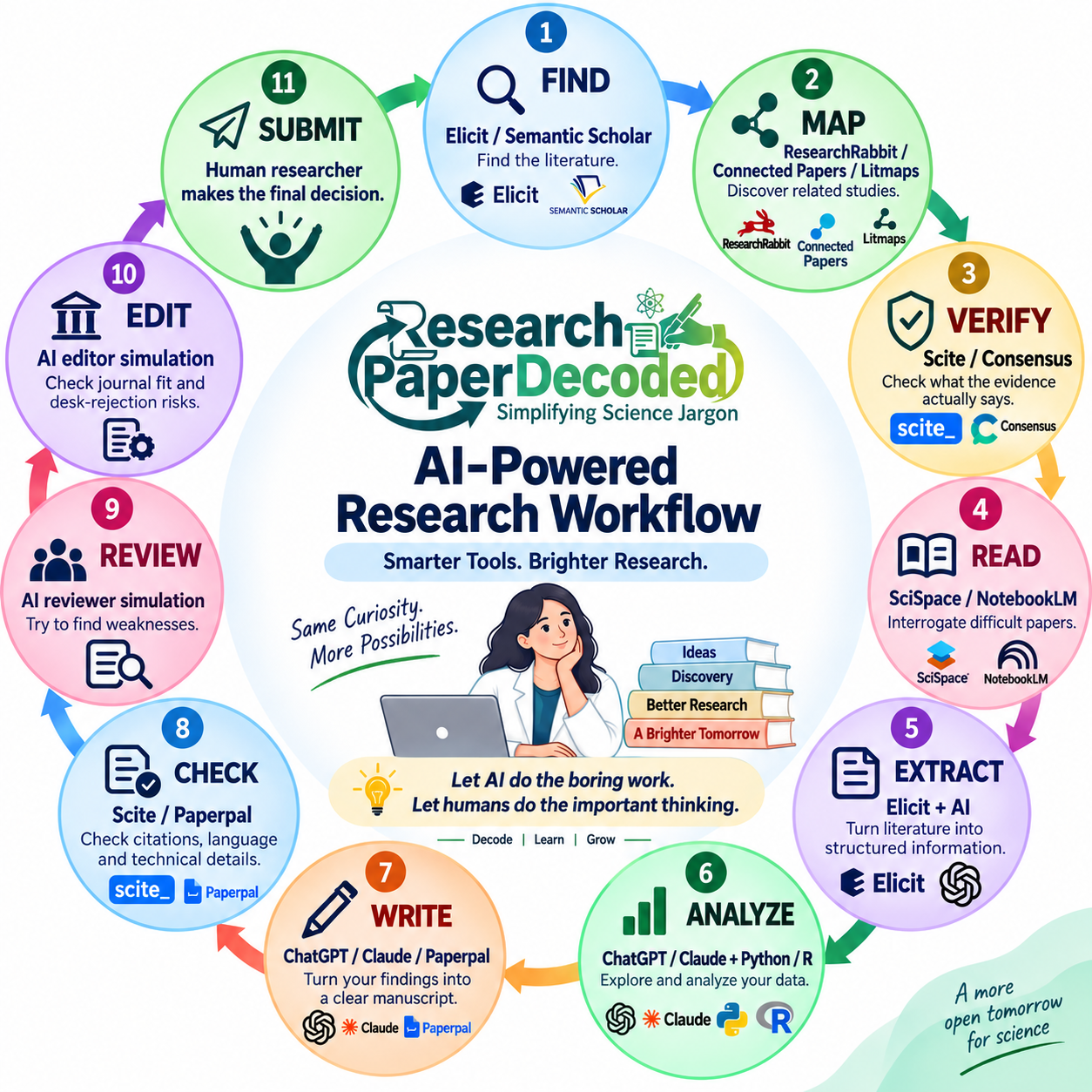
What Does the Complete AI Research Workflow Look Like?
Now we can put everything together and understand how modern AI tools can be used in academic research journey.
But Here’s What AI Still Can’t Do for You
After all this, it is tempting to think: “Great. I don’t need to do much anymore.” Unfortunately, science doesn’t work that way and it should not for dry lab also.
- AI can help you find a paper. But it cannot decide whether the experiment was worth doing.
- AI can summarize a result. But it cannot give you scientific judgment for free.
- AI can write statistical code. But it doesn’t make you responsible for understanding the statistics.
- AI can improve your English. But it doesn’t make your hypothesis correct.
- AI can simulate a reviewer. But it cannot predict exactly what a real reviewer will think.
- And most importantly: AI can make a wrong answer sound extremely convincing.
That is probably its greatest danger in scientific research.
The Best Rule for Using AI in Research
Here is the rule I would put above every researcher’s desk:
Let AI do the boring work. Let humans do the important thinking.
Use AI to search relevant paper and organize them. Take help of AI to compare and calculate. Use AI to find weaknesses as a reviewer would find. Use AI to improve your writing. But when it comes to:
What does this result mean? Is this conclusion justified? Whether this experiment scientifically sound? Is this really novel findings or should we believe this claim?
The final decision should remain with the researcher’s scientific knowledge, expertise and judgements.
The Future Researcher May Work Differently
The researcher of the future may not spend less time thinking. They may simply spend less time searching, sorting and formatting and more time asking better questions. Imagine starting your day with an AI research team:
Literature Scout:
“Here are 15 papers published this week that matter to your project.”
Evidence Checker:
“Two of the claims you used yesterday are actually disputed.”
Data Assistant:
“There are three unusual observations in your dataset.”
Writing Assistant:
“Your Discussion repeats the same argument four times.”
Reviewer:
“I found two weaknesses that could lead to major revision.”
And finally:
You:
“Interesting. Now let’s think.”
That may be the real promise of AI in scientific research. Not replacing researchers. Not turning everyone into an automatic paper-writing machine. But giving researchers more time to do the part of research that humans are still best at:
- Being curious.
- Questioning.
- Connecting ideas.
- And deciding what is actually worth believing.
The AI Researcher’s Toolkit
| Task | Tools to try | What they help with |
|---|---|---|
| Find papers | Elicit, Semantic Scholar | Literature discovery |
| Map literature | ResearchRabbit, Litmaps | Related studies |
| Verify claims | Scite | Citation context |
| Read papers | SciSpace, NotebookLM | Understanding papers |
| Extract data | Elicit + AI | Structured tables |
| Analyze data | ChatGPT/Claude + Python/R | Analysis & visualization |
| Write | Paperpal, ChatGPT, Claude | Academic writing |
| Check references | Scite, Paperpal | Citation quality |
| Review | AI reviewer simulation | Find weaknesses |
| Prepare submission | Paperpal | Technical checks |
You don’t need ten subscriptions. You don’t even need to use every tool. Start with one problem that currently wastes your time. Find an AI tool that can help with that problem. Then build your own workflow.
Because the most useful AI tool for a researcher isn’t necessarily the one with the most features. It is the one that gives you back time to think.

Editor, Research Paper Decoded