
If you are planning to backup all your experimental data after years of your Research work, let me tell you one thing that you are already late to buy a realistic external storage device. The best time to buy an portable external SSD drive is now. Do not wait to realize the need of your PhD data backup, buy before you face the worst.
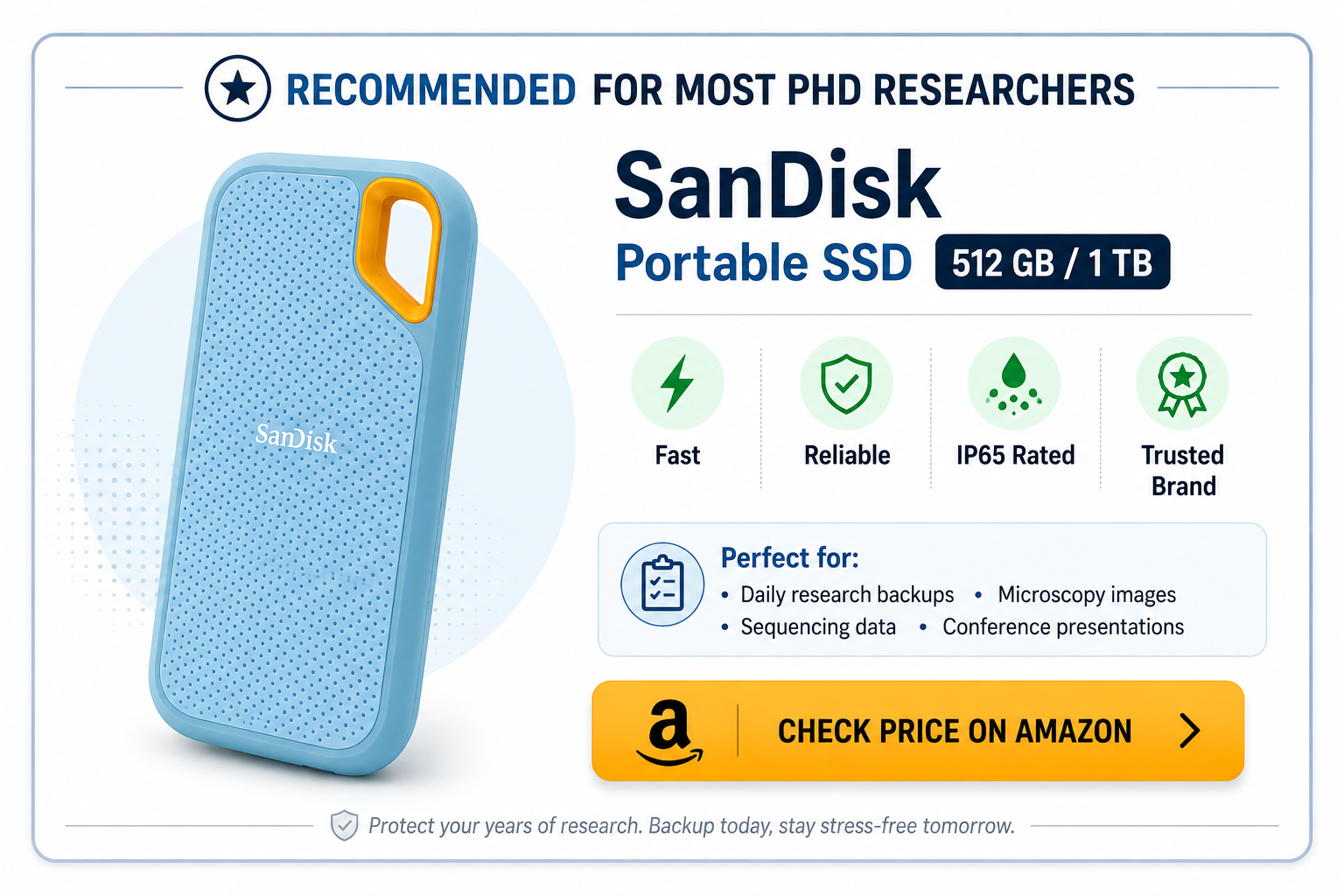
Recommended for most PhD researchers
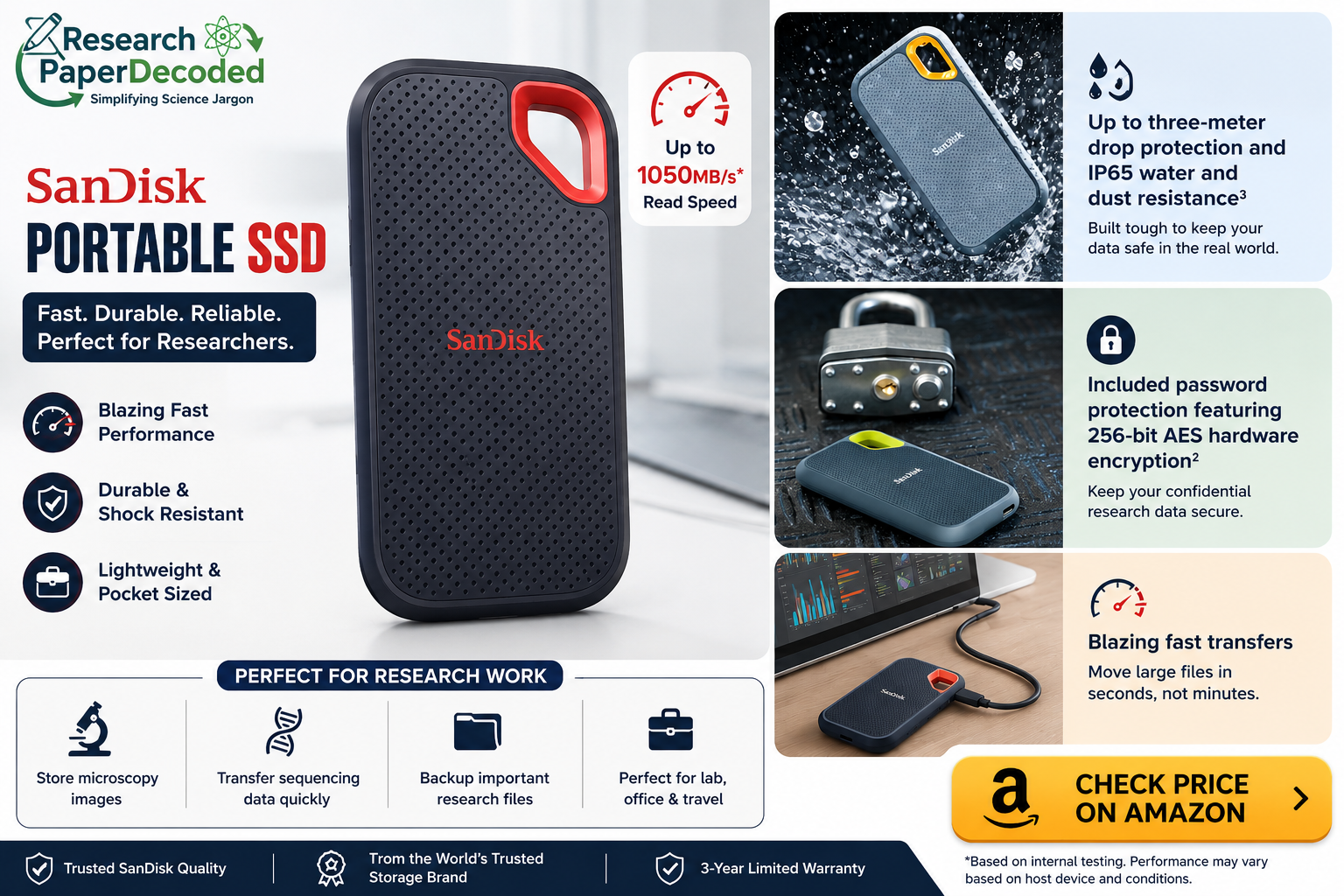
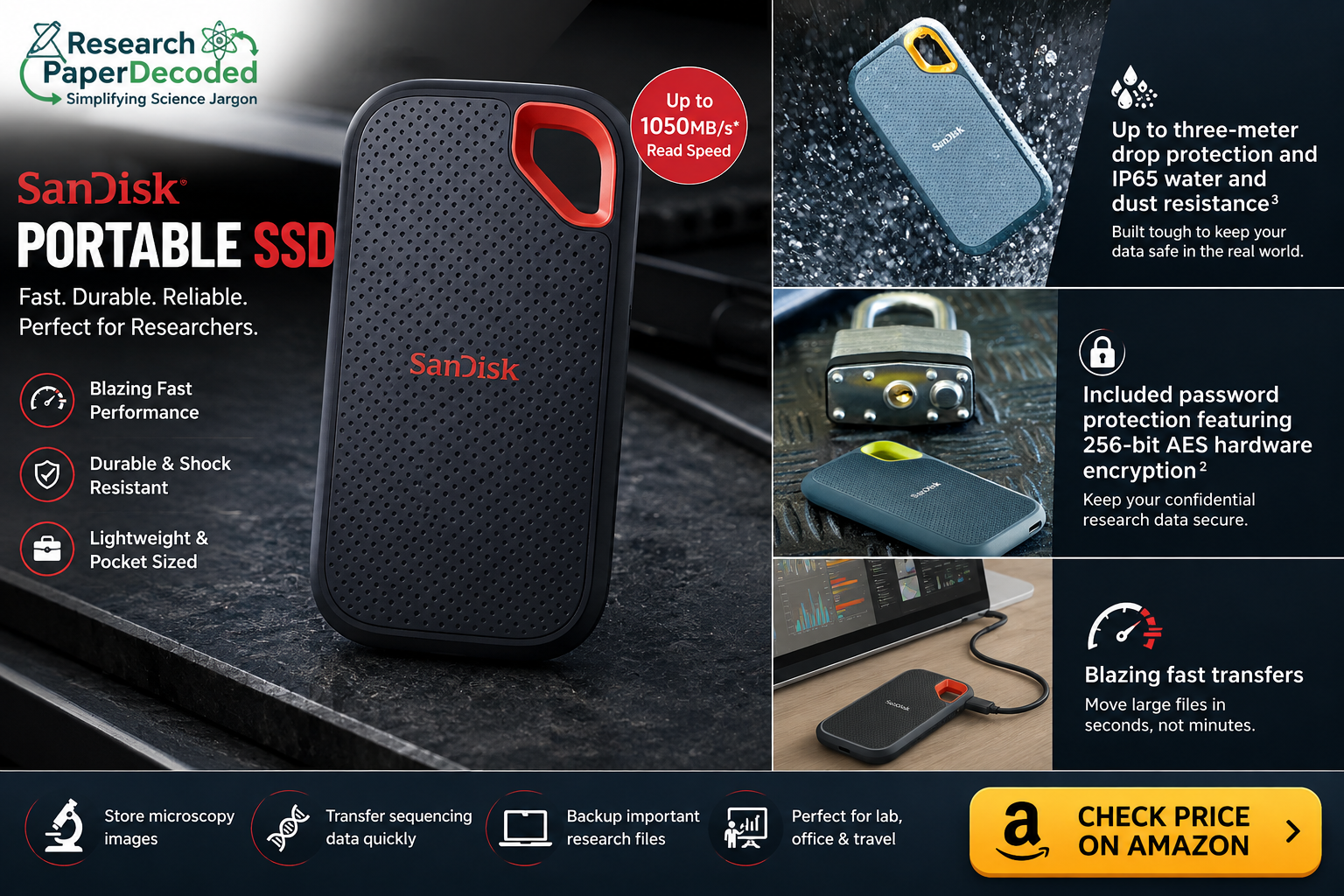
SanDisk Portable External SSD: 🟢 Fast 🟢Reliable 🟢IP65 Rated 🟢 Trusted brand
Ideal for daily research backups, microscopy images, sequencing data, and conference presentations.
Research Scholar Needs an External SSD Before It’s Too Late
“It won’t happen to me.” Almost every PhD research scholar believes this—until the day they lose their data. A laptop crashes the night before a progress seminar. An external hard drive stops responding after years of faithful service. A Windows update corrupts the operating system. Someone accidentally clicks Delete instead of Copy. Or perhaps the laptop simply disappears from a conference bag.
If you’re reading this before experiencing any of these situations, you’re already ahead of many researchers. Because across Reddit, Quora, graduate student forums, and research communities, one heartbreaking pattern appears again and again: most researchers start thinking seriously about data backup only after losing something they can never recreate. This article isn’t about buying another gadget. It’s about protecting years of your scientific journey you had and coming ahead.
A Story That Every PhD Student Should Read
A researcher shared on Reddit that they had trusted a backup before their university computer was reformatted. The backup had silently failed. When the computer was erased, approximately 4.5 years of PhD research disappeared. All the experimental data, original files, data analysis, manuscript and patent drafts lost due to an unintended silly mistake.

Imagine explaining that to your supervisor. Imagine preparing for your thesis defense knowing that your original datasets no longer exist. The most painful part? The researcher didn’t lose their work because of bad science.
They lost it because they believed one copy was enough.
“One Copy Is No Copy”
Spend a few minutes browsing graduate student communities online and you’ll notice experienced researchers repeating one sentence: One copy is no copy.
It sounds harsh. But it reflects reality. Researchers who have experienced data loss become almost obsessive about backups because they understand something that new students often don’t. Research is unlike ordinary office work. You can rewrite an email, recreate a presentation. But you cannot always recreate:
- six months of animal experiments,
- patient samples,
- microscopy images,
- sequencing runs,
- field recordings,
- or a once-in-a-lifetime experiment that depended on limited funding and precious samples.
Some experiments simply cannot be repeated.
Your Laptop Is Not Your Backup
One of the biggest misconceptions among research scholars is believing that saving files on a laptop means they are safe. You may have bought the perfect laptop for research work considering the long term requirement. But at the end of the day the laptop is your working environment, not your archive. Your laptop can fail because of:
- SSD failure
- Motherboard damage
- Water spills
- Power surges
- Theft
- Accidental formatting
- Malware or ransomware
- Operating system corruption
When your laptop fails, your research often disappears with it. Cloud storage certainly helps, but cloud storage alone is not the answer. Many researchers routinely work with: microscopy images, fluorescence videos, confocal image stacks, time lapse imaging, sequencing datasets, bioinformatics outputs, heavy simulation, complex designing, machine learning datasets. These files are often in large size and very crucial for continuous progress of the research. Each file represents hours, days, or months of work. Together, they represent years of your life.
These files quickly exceed free cloud storage limits. Internet access isn’t always available in laboratories, conferences, or field stations. Cloud storage is excellent for collaboration. It should never be your only backup.
Original Data Can Protect Your Scientific Contribution
Scientific discoveries don’t happen overnight. Ideas develop gradually through discussions, experiments, pilot studies, conference presentations, and repeated validation.
Imagine presenting exciting preliminary findings at a scientific conference. Months later, another group publishes a similar concept.
Questions naturally arise. Who generated the idea first? When were the experiments performed? Well-organized research records—including original instrument files, laboratory notebooks, version histories, and archived datasets with preserved creation dates—can help establish the chronology of your research.
It’s important to be clear: timestamps alone do not determine authorship or intellectual property. Those decisions depend on many factors, including documented contributions, institutional policies, publications, and laboratory records.
However, maintaining complete, time-stamped original datasets provides valuable supporting evidence and demonstrates good scientific record keeping. Your backup isn’t only protecting files. It is preserving the history of your scientific work.
Another Story Every Researcher Should Remember
In another widely discussed online post, a PhD student misplaced a storage drive containing dissertation recordings and valuable research data.
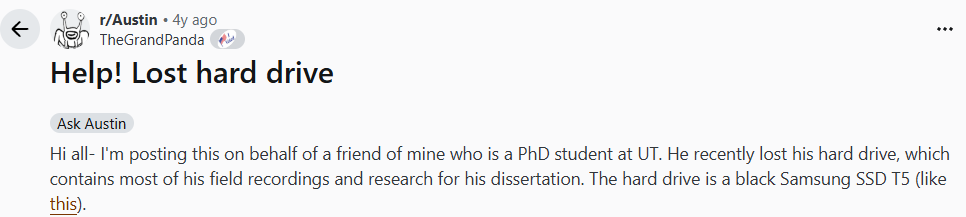
At first glance, this sounds like an argument against external storage. It isn’t. It teaches a different lesson. An external SSD should never become your only copy. It is one layer of a complete backup strategy. Because storage devices can be lost. Laptops can be stolen. Cloud accounts can become inaccessible. No single device should hold your entire research career. So suggestion will be keep at least 1 portable SSD device and if you can afford keeping data back in a 2nd external backup drive SSD/HDD will be the best decision for your life.
The Backup Strategy Used by Professionals
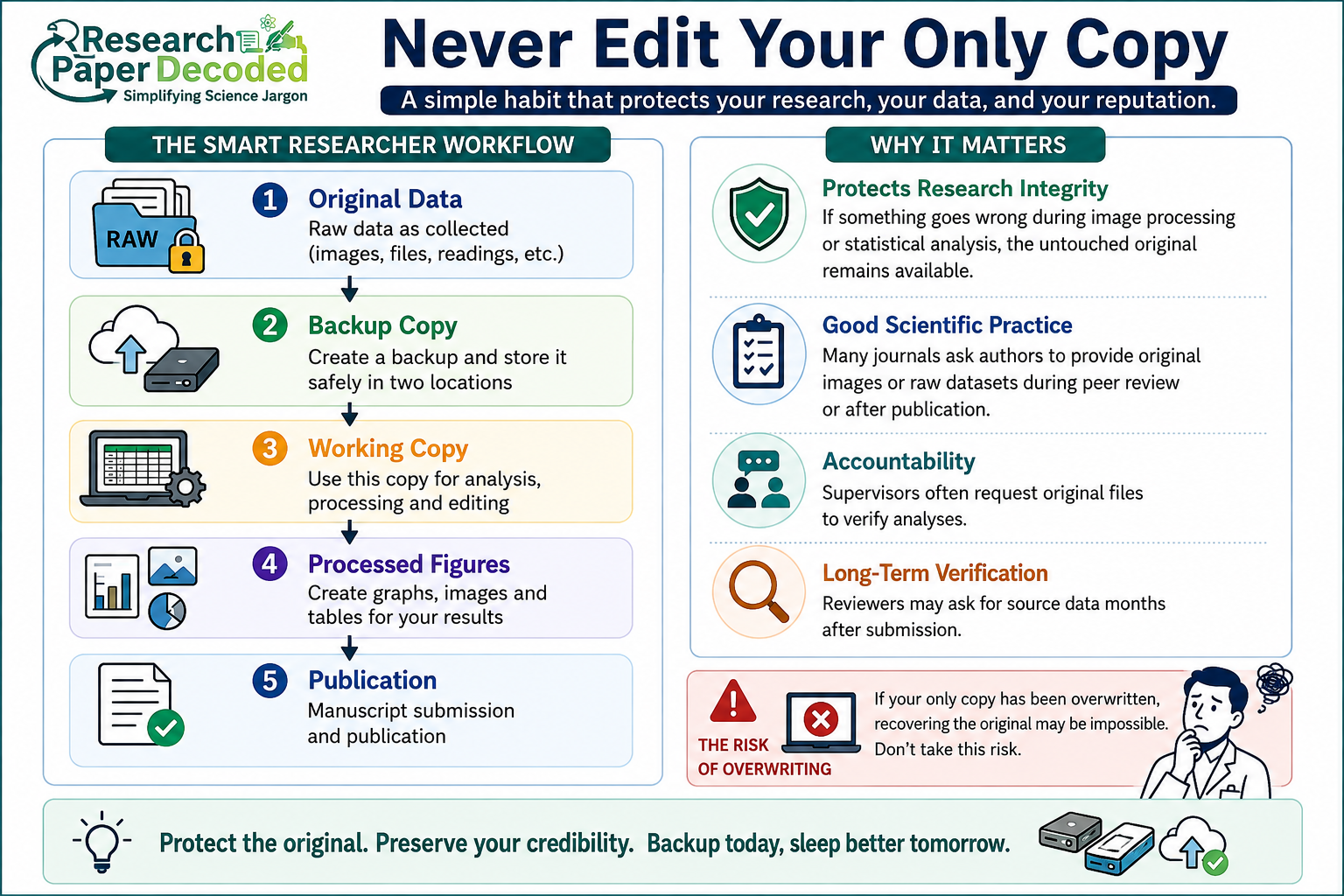
IT professionals recommend something called the 3-2-1 Backup Rule, and researchers can benefit enormously from following it. The idea is simple:
- Keep three copies of important data.
- Store those copies on two different storage media.
- Keep one copy in a separate location.
For most research scholars, the workflow looks like this: Laptop –> External SSD –> Cloud Storage or Institutional Server
Now imagine losing your laptop. Your SSD still contains your work. If the SSD is damaged, your cloud backup remains available. One unexpected accident no longer threatens years of research.
External HDD or External SSD?
Once researchers decide to purchase external storage, the next question is obvious. Should you buy an External Hard Disk Drive (HDD) or an External Solid-State Drive (SSD)?
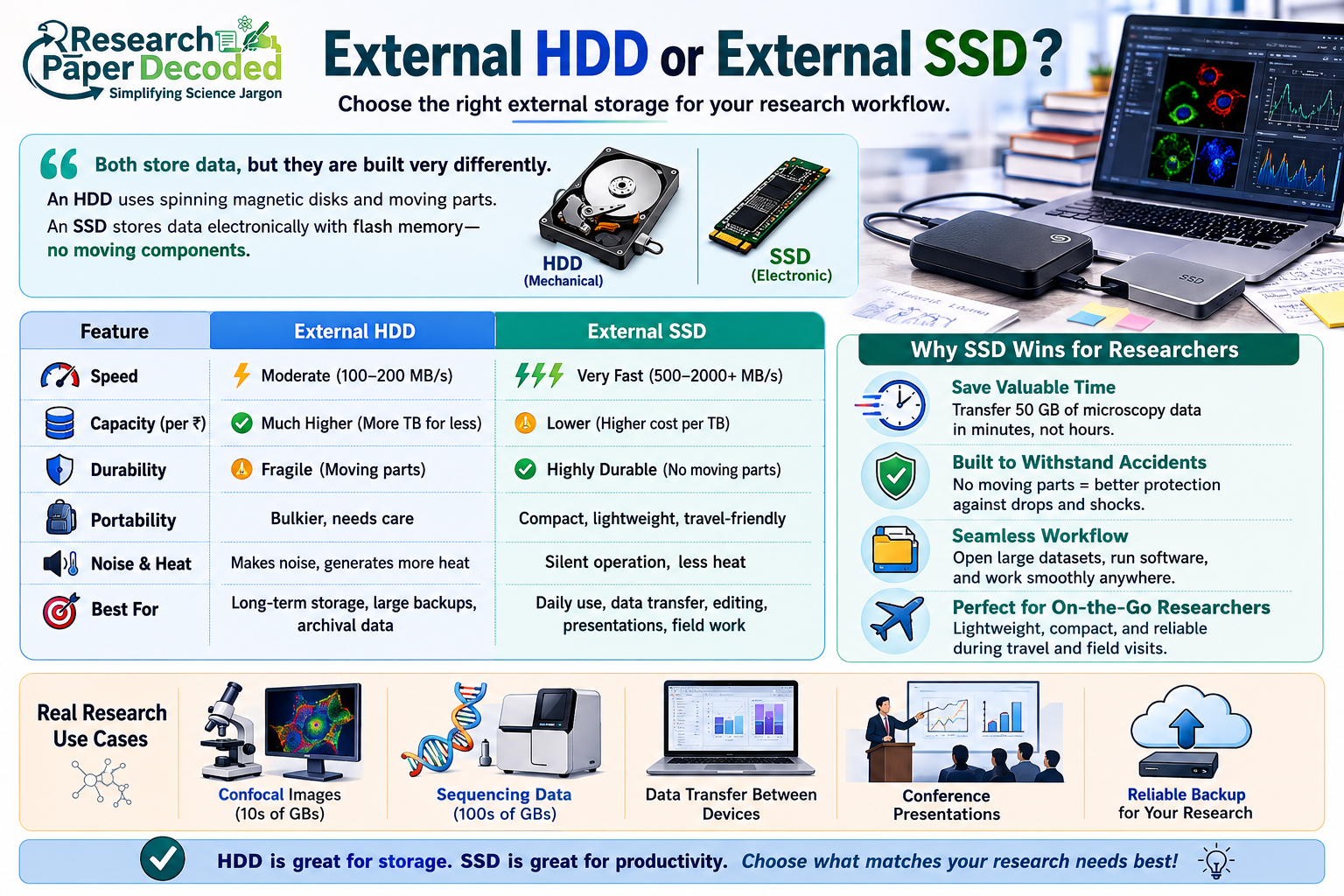
Both store data. But they are built very differently. An HDD contains spinning magnetic disks and moving mechanical parts. An SSD stores information electronically using flash memory with no moving components. That single engineering difference changes everything. An HDD is perfectly suitable for long-term archival storage when maximum capacity at the lowest cost is your priority. An SSD, however, is designed for speed, portability, durability, and everyday professional use. For researchers, these advantages matter more than they first appear.
Imagine copying 50 GB of confocal microscopy images after finishing an experiment. Or transferring sequencing files between your laboratory computer and personal laptop or opening large datasets during a conference presentation. An SSD drive completes these tasks dramatically faster than a traditional hard drive, allowing you to spend more time analyzing data instead of waiting for progress bars.
Equally important, SSDs have no moving mechanical components, making them much more resistant to accidental threats. For researcher scholar who carry data almost every day, this added durability is invaluable.
A Smarter Way to Use Your Research Budget
Many fellowships and sponsored research projects provide contingency or project funds intended to support research activities, subject to institutional and funding agency rules. Researchers often use these funds for books, software, conference registration, laboratory consumables, and essential equipment.
A data backup storage drive can also be a reasonable research-related purchase in many situations because it directly supports secure data management and long-term preservation of valuable research outputs.
Before purchasing, always consult your supervisor and follow your institute’s procurement policies.
Viewed this way, buying an external SSD isn’t simply purchasing another electronic device. It is investing in the security of years of scientific effort.
The Most Expensive Storage Device Is the One You Buy Too Late
Researchers often postpone buying backup storage. “I’ll buy one after my next fellowship.” “I’ll wait until this semester ends.” “My laptop is still working.”
The problem is that hardware failures rarely arrive with a warning. The best time to create a backup is before you need it not after. The best time to create your backup is before you need it. Even if storage prices fluctuate, delaying a purchase can be far more expensive than losing irreplaceable research data.
Final Thoughts
One day your PhD will end. You’ll submit your thesis. Publish your papers. Move to a postdoctoral position, industry, or another research institute. Years later, someone may ask: “Do you still have the original data?”
That is not the day you should begin thinking about backups. It is the day you should be grateful that you started protecting your research years earlier. Your laptop is temporary. Your experiments are irreplaceable. Your publications will represent your scientific career. Protect them accordingly.
Research Paper Decoded Recommendation
If recreating your research data would take more than a week, you should already have an external backup device.
In our next guide, we’ll compare the best 1TB and 512GB external SSDs for research scholars in India, helping you choose the right drive based on your research workflow, budget, and long-term storage needs.

Editor, Research Paper Decoded