
Oral cancer patients often receive the same chemotherapy drugs, yet their outcomes can be very different. One patient responds well, while another shows little improvement. This difference is not random — it reflects how each tumor behaves biologically.
Despite this, most treatment decisions are still made without directly testing how a patient’s tumor will respond to drugs. Therapies are chosen based on clinical guidelines and population data, not on functional evidence from the tumor itself.
This study explores a simple but important idea:
What if we could test chemotherapy directly on a patient-like tumor model before starting treatment?
To do this, the researchers developed a 3D spheroids-on-a-chip platform that allows oral cancer drug responses to be tested under conditions that closely resemble the tumor environment.
Original Research Paper Details:
Paper Title: 3D stem-like spheroids-on-a-chip for personalized combinatorial drug testing in oral cancer
Author Details: Viraj Mehta, Sukanya Vilikkathala Sudhakaran, Vijaykumar Nellore, Srinivas Madduri and Subha Narayan Rath*.
DOI: https://doi.org/10.1186/s12951-024-02625-y
Journal: Journal of Nanobiotechnology
Why Traditional Drug Testing Often Fails?
Most anticancer drugs are first evaluated using 2D cell cultures, where cancer cells grow as flat layers on plastic. These systems are easy to handle, but they miss several key features of real tumors:
- Real tumors grow in three dimensions
- Drugs do not penetrate evenly
- Oxygen levels vary within the tumor
- Aggressive, stem-like cells survive treatment
As a result, drugs that appear effective in 2D often fail when tested in patients.
A 3D Spheroids-on-a-Chip Drug Testing Platform- The Solution
In this study, researchers developed a microfluidic device designed to host three-dimensional spheroids derived from oral cancer cells. These spheroids form spontaneously when cells are cultured in a non-adherent environment and quickly develop characteristics similar to real tumors, including:
- Compact 3D architecture
- Natural resistance to chemotherapy
- Oxygen gradients reflecting tumor hypoxia
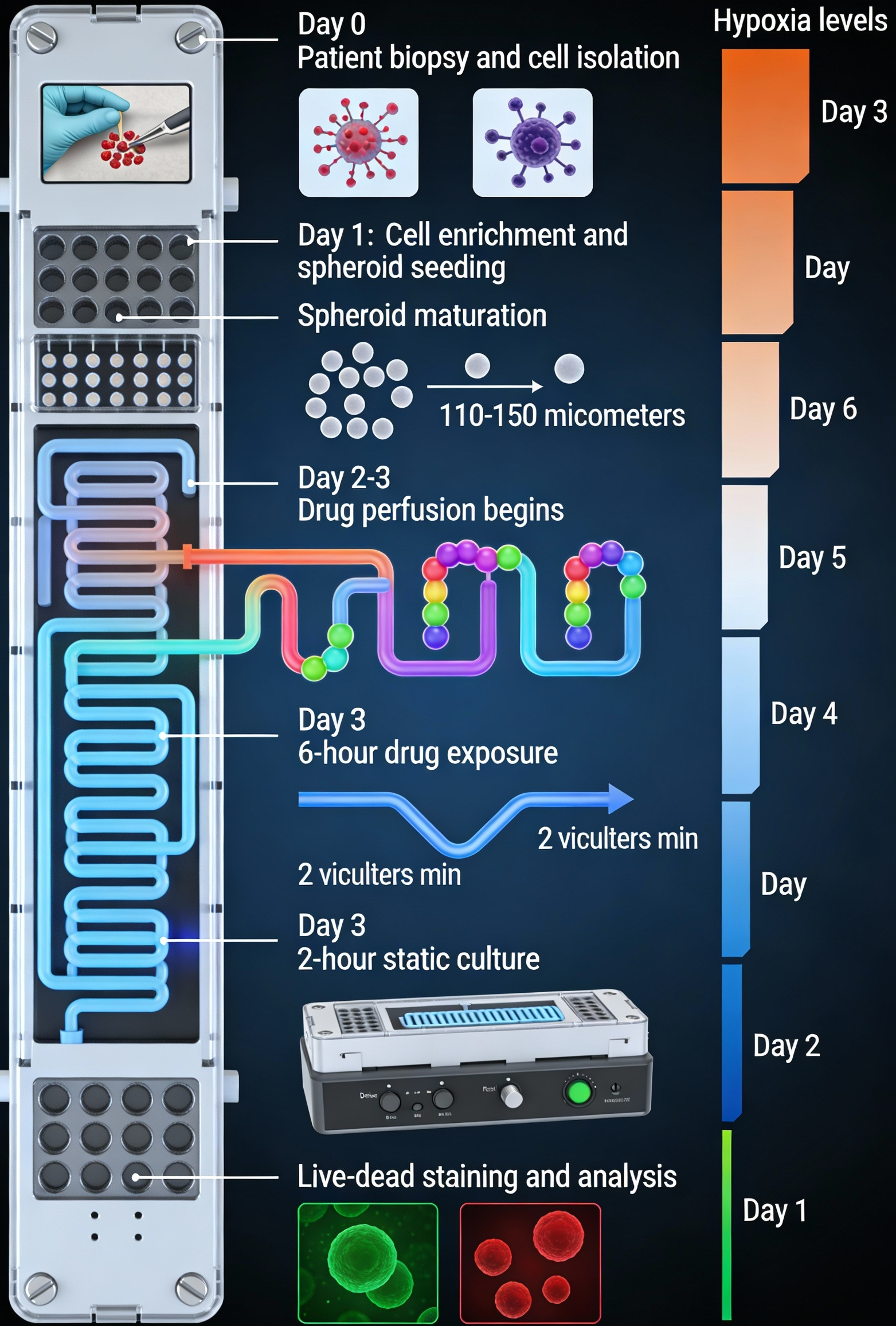
Once formed, the spheroids are placed into chambers inside the microfluidic chip. The chip’s microchannels deliver nutrients and drugs under controlled flow, creating an environment that better mimics circulation in the human body.
The Device Spheroid-on-a-Chip
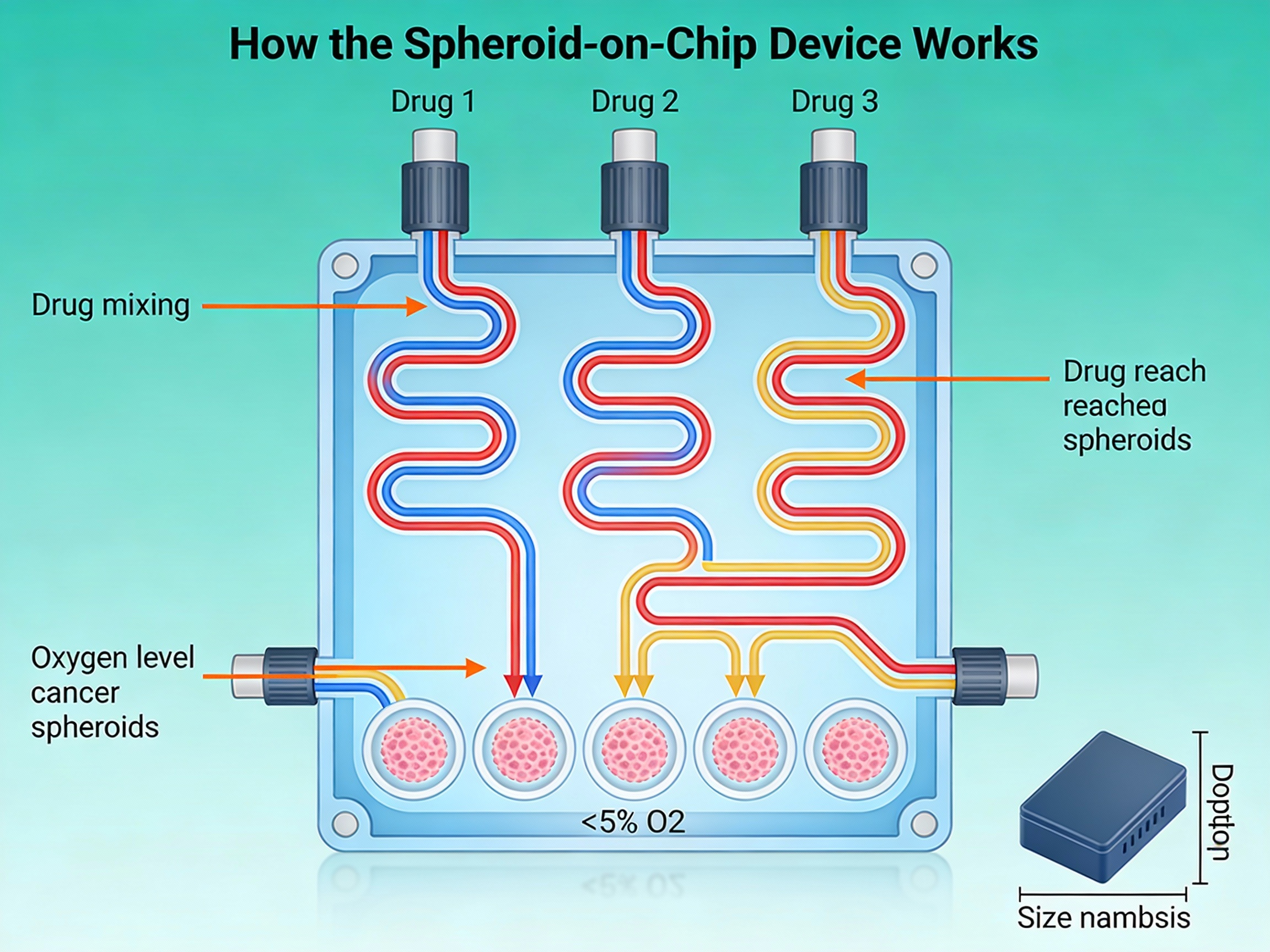
At the heart of this study is a microfluidic chip designed to test many drug combinations at once. The chip contains seven parallel channels, each ending in a small cluster of seven microwells — 49 wells in total. Each well holds one tumor spheroid.
As drugs flow through the channels, serpentine paths mix three chemotherapy agents in defined ratios before they reach the spheroids. This allows different drug combinations to be delivered simultaneously, under continuous flow rather than static soaking — much closer to how chemotherapy reaches tumors in the body.
Inside the chip, multiple chemotherapy drugs – both alone and in combination – can be delivered to the spheroids, allowing simultaneous testing of different regimens on the same tumor model.
Building Patient-Like Oral Tumors
Using this device, the researchers cultured patient-derived oral cancer spheroids enriched for stem-like cancer cells. These spheroids:
- Formed compact, uniform 3D structures
- Maintained high viability (>90% for at least 5 days)
- Remained relatively small (generally <150 µm)
- Showed strong expression of CD44, a key oral cancer stem cell marker
This confirmed that the system preserved the most clinically relevant – and drug-resistant – tumor cell population.
Testing Chemotherapy Combinations
The chip was used to test a standard oral cancer chemotherapy regimen:
- Paclitaxel
- 5-Fluorouracil
- Cisplatin
These drugs were delivered as single agents and in combinations, generated directly on the chip through controlled mixing.
What emerged was a clear pattern:
- Spheroids from one patient showed strong resistance to all drug combinations
- Spheroids from another patient showed substantial cell death
- A third patient’s spheroids showed intermediate sensitivity
Even within the same drug condition, some spheroids survived while others did not, revealing hidden heterogeneity within individual tumors.
Hypoxia and Drug Resistance Go Hand in Hand
One of the most consistent observations was the link between low oxygen levels and drug resistance.
Spheroids with oxygen levels below 5% similar to solid tumors in patients – were the most resistant to chemotherapy. Hypoxia is known to:
- Reduce drug effectiveness
- Promote stem-like behavior
- Activate survival pathways
By preserving these oxygen gradients, the chip revealed resistance mechanisms that are invisible in conventional 2D cell cultures.
Why This Matters
These patterns do not appear in standard 2D cultures. Only 3D spheroids under realistic flow and hypoxia reveal true patient-specific drug resistance.
This approach allows oncologists to ask:
Which drugs actually work for this specific tumor?
Potential benefits:
- Reduce ineffective chemotherapy
- Avoid unnecessary toxicity
Enable evidence-based, personalized treatment
What the Study Does – and Does Not – Claim
The authors do not suggest that this platform is ready for routine clinical use. It currently lacks immune cells, stromal components, and large patient cohorts. The study done on n=3 patient samples only.
However, as a functional drug-testing model, it represents a meaningful step toward personalized cancer therapy – one that complements genetic and molecular profiling rather than replacing it.
The Bigger Picture
Genomic data can predict what a tumor might do.
Functional models show what a tumor actually does.
By combining patient-derived tumor spheroids with controlled microfluidic drug delivery, this study demonstrates how cancer treatment decisions could one day be guided by direct evidence from tumor behavior, not educated guesswork
Research Paper Decoded Quick Take
Problem:
Standard lab models fail to predict how individual oral tumors respond to chemotherapy.
What was done:
Patient-derived 3D oral cancer spheroids were grown in a microfluidic chip and exposed to multiple drug combinations.
Key insight:
True drug resistance appears only in realistic 3D, low-oxygen environments.
Why it matters:
This approach brings oral cancer treatment closer to functional, patient-specific decision-making.

Editor, Research Paper Decoded