
Different Types of PCR and Why They Exist in Real Labs
Basic Principle + Experimental Need + How Each Type is Different (Concept Builder)
PCR (Polymerase Chain Reaction) is often introduced as a simple technique:
DNA → amplify → band on gel.
But once you enter a real laboratory, you quickly realize something important:
👉 PCR is not one method.
👉 PCR is a family of methods created to solve real experimental problems.
Because in real research, your samples are not perfect, your targets are not always abundant, and your results are not always clean.
Sometimes PCR gives:
multiple bands
primer-dimers
no amplification
weak signal
inconsistent repeats
“it worked yesterday but not today” behavior
So scientists didn’t invent PCR variants for fun.
They invented them because standard PCR was not enough for every experimental need.
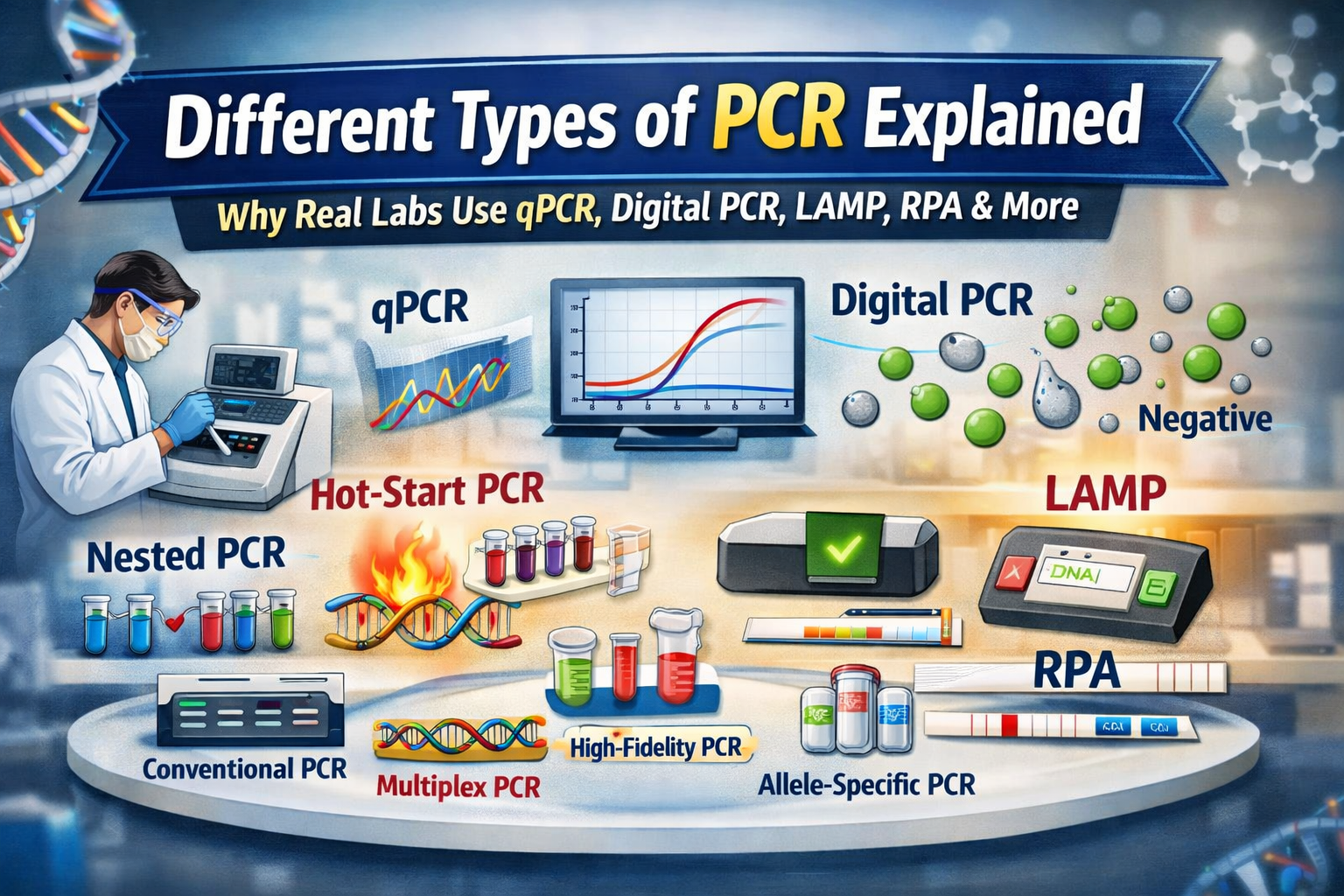
In this article, we will classify PCR types using a lab-friendly strategy:
✅ Category 1: Similar amplification process
(PCR types made to improve how amplification happens)
✅ Category 2: Similar result interpretation / amplicon product
(PCR types chosen mainly by how results are read, quantified, or used in diagnostics/field settings)
The Core PCR Principle (common to almost every type here)
All PCR-based methods rely on a simple idea:
You need:
Template (DNA or cDNA)
Primers (define the target)
Polymerase (key enzyme)
dNTPs + Mg²⁺ + buffer
Correct temperature/time conditions
Classic PCR cycles through:
Denaturation (separate DNA strands)
Annealing (primers bind)
Extension (polymerase extends)
[Read this article to know about the mechanism of PCR]
Now let’s see how real labs modify this basic system.
CATEGORY 1 : PCR Types With Similar Amplification Process
(Same PCR cycling idea, but engineered to fix specificity, yield, and accuracy problems)
These PCR types exist because the biggest pain in standard PCR is:
“Amplification is happening, but not in the way I want.”
1) Conventional PCR (End-point PCR)
Real lab need : You want a quick answer:
Is my gene present?
Did I amplify the right fragment?
Did cloning work?
Principle: Standard denaturation–annealing–extension cycles.
How it’s different: It is the baseline PCR.
How results are usually checked:
Agarose gel:
✅ band present / ❌ band absent
Reality check: It’s great for detection, but it is not truly quantitative.
2) Hot-Start PCR
Real lab need: You keep getting:
extra bands
primer-dimers
inconsistent results
Even when primers are correct.
This happens because PCR can start mis-amplifying during setup, before cycling begins.
Principle: Polymerase stays inactive until high temperature activates it.
What it improves:
reduces non-specific amplification
reduces background
improves reproducibility
Lab truth: Hot-start PCR doesn’t replace good primer design, but it saves many experiments.
3) Touchdown PCR
Real lab need: Your PCR gives:
faint correct band + extra bands
or wrong bands only
or “smear-like” amplification
Often because annealing temperature is not ideal.
Principle: Start with high annealing temperature (strict binding) and gradually decrease it (better yield).
Why it works:
Early cycles decide specificity.
Touchdown makes early cycles highly selective.
Best use: difficult primers, genomic targets, GC-rich templates.
4) Nested PCR
Real lab need: Your target is present but extremely low:
early infection
low copy pathogen DNA
degraded DNA
complex samples with inhibitors
Standard PCR gives no band or non-specific products.
Principle: Two rounds of PCR:
Round 1: outer primers
Round 2: inner primers (inside the first amplicon)
What it improves:
sensitivity
specificity
Important lab warning: contamination risk increases because tubes are opened between rounds.
5) Multiplex PCR
Real lab need: You cannot afford to run 5 separate PCRs per sample. But you want:
multiple pathogens
multiple genes
internal control + target in one tube
Principle: Multiple primer pairs amplify multiple targets in one reaction.
What becomes challenging: PCR becomes competitive.
primers compete
targets amplify unevenly
primer-dimers become more likely
Best use: diagnostic panels, screening assays, internal control inclusion.
6) High-Fidelity PCR
Real lab need: Your PCR product looks perfect on gel, but downstream experiments fail:
cloning gives wrong sequence
expression produces faulty protein
sequencing shows mutations
This happens because standard polymerases (like Taq) can introduce errors.
Principle: Use proofreading polymerases with much lower error rate.
What it improves: Accuracy of the amplified sequence.
Best use: cloning, sequencing preparation, mutagenesis, functional studies.
7) Long-Range PCR
Real lab need: You need to amplify large fragments (several kb to tens of kb). Standard PCR struggles or fails.
Principle: Special polymerase systems and conditions support long extension.
What it changes:
longer extension times
higher enzyme stability
template DNA quality becomes critical
Best use: large genes, genomic regions, structural variant confirmation.
CATEGORY 2 : PCR Types With Similar Result Interpretation / Amplicon Product
(The method is defined by how you “read” the result, quantify it, or use it in real-world workflows)
This category answers a different question:
“What kind of output do I need from amplification?”
Sometimes amplification is not the challenge.
Interpretation is the real science.
1) qPCR (Real-Time PCR)
Real lab need: You don’t want just “present/absent.”
You want how much target was there. For examples:
viral load monitoring
bacterial burden
gene expression changes
validation experiments
Principle: Fluorescence is measured during each cycle, producing:
amplification curve
Ct/Cq value
Why it belongs here: qPCR is defined by result interpretation (real-time fluorescence), not just amplification.
Lab tip: SYBR Green is cheaper but can detect non-specific products too. Probes increase specificity.
2) Digital PCR (dPCR) — Best placed in Category 2
Real lab need: Sometimes qPCR is not enough, especially when:
target is extremely low
rare mutation exists in a wild-type background
copy number differences are small but critical
Principle: Sample is partitioned into thousands of micro-reactions.
Each partition becomes:
Positive
Negative
Then absolute concentration is calculated.
Why it belongs here: dPCR is defined by counting positives, not Ct curves.
In short: Digital PCR (dPCR) turns amplification into a precise counting experiment.
3) RT-PCR / RT-qPCR (For RNA Targets)
Real lab need: Many important questions involve RNA:
gene expression
RNA virus detection
transcript confirmation
PCR cannot amplify RNA directly.
Principle:
RNA → cDNA (reverse transcription) → PCR/qPCR.
Why it belongs here: The “product meaning” changes: you are now measuring RNA indirectly through cDNA.
Lab truth: RNA quality and DNA contamination control (no-RT control) matter a lot.
4) Allele-Specific PCR (AS-PCR / ARMS PCR)
Real lab need: Sometimes one nucleotide decides everything:
drug resistance mutation
inherited mutation
SNP genotyping
cancer hotspot variants
Sequencing is great, but for rapid screening, labs use targeted PCR logic.
Principle: Primers are designed so amplification happens only if the allele matches perfectly.
Why it belongs here: The interpretation becomes:
amplification = specific allele is present
Key limitation: primer design must be strict, or false positives occur.
5) Methylation-Specific PCR (MSP)
Real lab need: Not all biological changes are mutations.
Epigenetic changes like DNA methylation can act as disease biomarkers.
Principle: Bisulfite treatment changes unmethylated cytosines, enabling PCR discrimination between methylated vs unmethylated DNA.
Why it belongs here: Because the “amplicon meaning” is about methylation state, not just sequence presence.
Lab reality: bisulfite conversion can degrade DNA—sample handling is critical.
6) LAMP (Loop-Mediated Isothermal Amplification)
Real lab need: PCR needs a thermal cycler.
But many real-world diagnostic settings need:
rapid detection
low equipment requirement
point-of-care workflow
visual readout options
Principle (simple view)
LAMP amplifies DNA at a constant temperature using multiple primers and strand displacement, producing massive amounts of product quickly.
Why it belongs here: LAMP is often chosen because the readout can be:
color change
turbidity
fluorescence
lateral flow style detection
Lab truth: LAMP is powerful but primer design is complex and contamination control is essential.
7) RPA (Recombinase Polymerase Amplification)
Real lab need: Sometimes you need amplification that works:
at low temperature (~37–42°C)
in very short time (often 10–20 minutes)
with portable or field-ready setups
Principle: Recombinase helps primers invade dsDNA, and polymerase extends using strand displacement—no thermal cycling.
Why it belongs here: RPA is selected for its workflow advantages and easy downstream interpretation:
fluorescence
lateral flow strips
CRISPR-Cas detection coupling (common in modern diagnostics)
Lab truth: RPA can be fast but may show non-specific amplification if primers are not well designed.
Which PCR Method Will Be Best For Your Experimental Need? Let’s Decode It (goal → best method → why → common mistakes)
Goal: “I only need presence/absence”
Best: Conventional PCR
Why: Simple, cheap, fast
Mistake: No positive control → you can’t interpret negatives
Goal: “Extra bands / primer-dimers are ruining my gel”
Best: Hot-Start PCR
Why: prevents early non-specific amplification
Mistake: expecting it to fix bad primers completely
Goal: “Multiple targets in one tube”
Best: Multiplex PCR
Why: saves time and adds internal controls
Mistake: primer competition and poor primer compatibility
Goal: “Sequence accuracy matters (cloning/sequencing)”
Best: High-Fidelity PCR
Why: fewer polymerase errors
Mistake: using Taq and later blaming cloning
Goal: “My fragment is very long”
Best: Long-Range PCR
Why: designed for long templates
Mistake: using short extension time or degraded DNA
Goal: “I need quantification”
Best: qPCR
Why: Ct-based measurement gives relative quantification
Mistake: trusting Ct without efficiency/controls
Goal: “My starting material is RNA”
Best: RT-PCR / RT-qPCR
Why: converts RNA to cDNA for amplification
Mistake: ignoring RNA degradation and genomic DNA contamination
Goal: “One mutation/SNP matters”
Best: Allele-Specific PCR / ARMS
Why: amplification becomes allele detection
Mistake: poor primer design → false positives
Goal: “Field-friendly (POC) rapid detection without thermal cycler”
Best: LAMP or RPA
Why: isothermal, fast, portable, flexible readouts
Mistake: contamination and non-specific amplification risks
Research Paper Decoded Quick Take
PCR types exist because real experiments demand different outputs:
Category 1 (Amplification-control PCRs)
Hot-start, Touchdown, Nested, Multiplex, High-fidelity, Long-range → designed to improve specificity, yield, and accuracy.
Category 2 (Readout/product-driven methods)
qPCR, Digital PCR, RT-PCR, Allele-specific PCR, MSP, LAMP, RPA → defined by how results are interpreted or how the amplicon is used in real workflows.
If you learn PCR this way, you stop memorizing names and start thinking like a researcher.

Editor, Research Paper Decoded